

Every year, the same question comes up a few weeks before the first big holiday dinner: will everyone actually fit around the table? The answer comes down to two measurements — how much table edge each guest needs, and how much floor space their chairs need behind them. Get those two right and you can choose a table that works for an ordinary weeknight and still stretches to a full holiday table.
The Two Numbers That Decide Everything
24 Inches of Table Edge per Guest
Plan on about 24 inches of table edge for each person. That leaves room for a plate, glassware and elbows without bumping a neighbor. If your chairs have arms, or you simply like a more relaxed table, plan on 28 to 30 inches per person instead.
36 Inches of Clearance Around the Table
Leave at least 36 inches between the edge of the table and the nearest wall or piece of furniture, so guests can pull a chair out and sit down. Where people need to walk behind seated guests — on the way to the kitchen, a hallway or a sideboard — 42 to 48 inches is more comfortable.
A quick way to check your room: add 72 inches (36 on each side) to the table's length and width. That's the minimum floor space the table and its chairs need.
Round Tables: How Many Fit Around Each Size
Round tables are the easiest to host around. Nobody sits at a corner, everyone can see everyone else, and the conversation stays in one piece. As a rule of thumb:
- 36 to 44 inches: 2 to 4 people — a breakfast nook or a small apartment
- 45 to 50 inches: 4 people comfortably
- 54 to 60 inches: 4 to 6 people — the sweet spot for most dining rooms
- 72 inches: 8 people
The base matters more than most people expect. A pedestal has no legs at the edge of the table, so you can pull in an extra chair for a holiday dinner without anyone straddling a table leg.

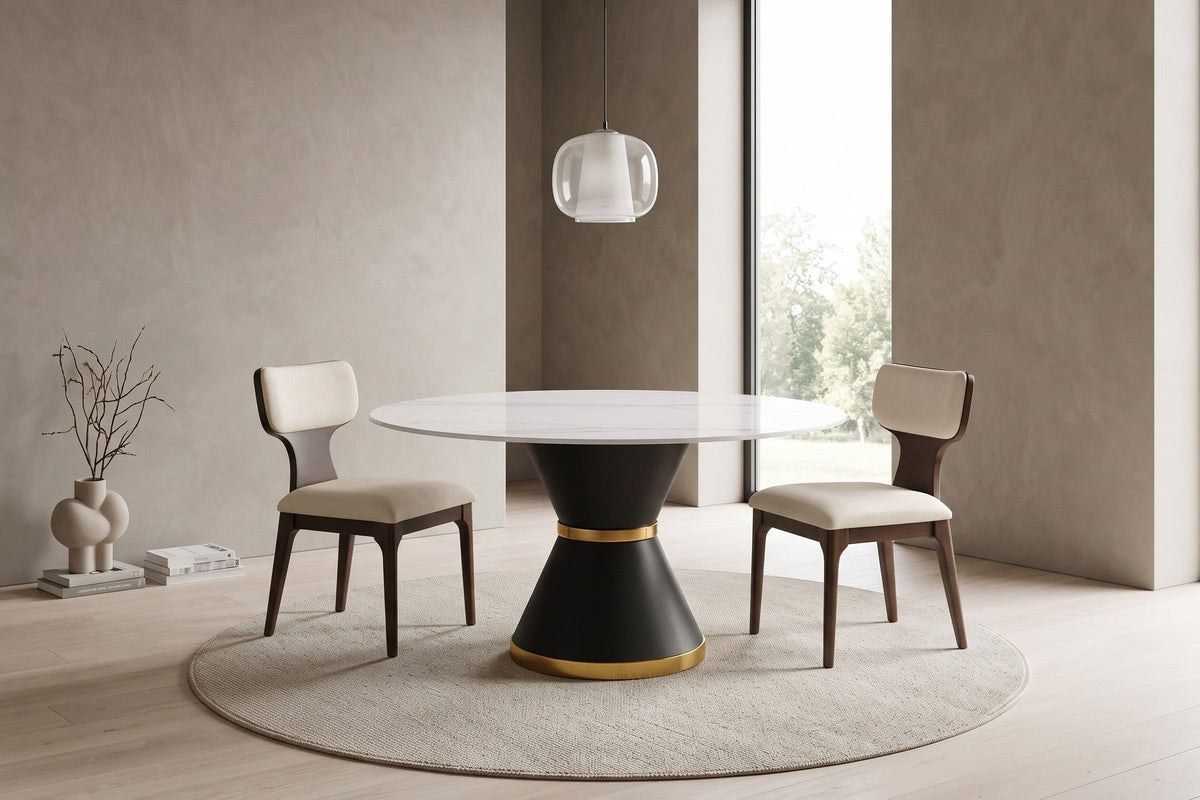
Shown: Orsay Round Sintered Stone Dining Table
The Orsay is a 59-inch round that seats four every day and six for dinners, on a single hourglass pedestal that keeps the space around the edge open for knees and extra chairs. Its sintered stone top resists heat and stains and wipes clean, which counts for a lot after a holiday meal with gravy and red wine on the table — we cover how stone tops compare in our guide to luxury stone tables. The Marais is the same 59-inch size in black sintered stone with fine gold veining, on four slim iron legs. Either one needs a room of about 11 by 11 feet.
Rectangular and Oval Tables: Length vs. Seats
For rectangular and oval tables, length sets the guest count:
- 60 to 63 inches: 4 to 6 people
- 70 to 72 inches: 6 people
- 84 to 90 inches: 6 to 8 people
- 94 to 96 inches: 8 people
- 108 inches and up: 10 or more
Width matters too. Most rectangular tables are 36 to 40 inches deep, which leaves room for place settings on both sides and a serving dish down the middle. A narrower table is a smart choice for a long, narrow dining room or an open-plan space where every inch of walkway counts.

Shown: Rivoli 63" Sintered Stone Dining Table
The Rivoli is 63 inches long but only 31.5 inches deep, so it seats six for dinner in a room of about 11 by 9 feet, where a standard-depth table would feel cramped. Its sculpted crescent base sits under the middle of the table, leaving both ends open for a chair. If you'd rather have wood and a softer shape, the solid ashwood Morel has rounded ends on two round pedestal legs and comes in 63- and 71-inch lengths. The 71-inch seats six comfortably.
If you seat eight or more every year, look at tables 94 inches and longer. Or keep the everyday table you love and set up a second table nearby for the kids.
Don't Forget the Chairs
The table sets how many people can fit; the chairs decide whether they actually do. Three things to check:
- Seat height: most dining tables are 29 to 30 inches high, so look for a seat height of 18 to 19 inches. That leaves 10 to 12 inches between the seat and the tabletop.
- Chair width: armless chairs around 20 inches wide fit the 24-inch rule. Armchairs are usually wider, so you may fit one fewer per side. A common fix is armchairs at the ends and armless chairs along the sides.
- Comfort for long meals: holiday dinners run long. A padded seat and a supportive back matter more than they do at a quick weeknight meal.

Shown: Colette Chenille Dining Chair, Set of 2
The Colette is 20 inches wide with a 19-inch seat height — right in range for a standard 29.5-inch table — and its foam-padded chenille seat and back are made for lingering over dessert. For a mid-century look, the Bastien wraps a cushioned seat in walnut-finish bentwood. We go deeper on comfort, materials and fit in How to Choose Dining Chairs That Actually Get Used.
Hosting More People Than Usual?
You don't need to buy for the one night a year when the whole family comes over. Buy for how you live most of the year, then plan for the extras:
- Pick a pedestal. A round pedestal or double-pedestal table takes an extra chair more easily than a table with a leg at each corner.
- Keep two spare chairs nearby. Matching dining chairs work well at a desk, in a bedroom corner or in an entryway, and come back to the table when you need them.
- Pull the table off the wall. For the evening, move it so every side can be used.
- Serve from somewhere else. Set the food out on a sideboard or kitchen counter so the table only has to hold place settings.
Compare sizes, shapes and finishes in the full Dining Tables collection.
Frequently Asked Questions
What size dining table seats 6?
A 60-inch round table or a rectangular table 70 to 72 inches long seats six comfortably. A 60- to 63-inch rectangular table also seats six for dinner if two guests sit at the ends.
How much space do you need around a dining table?
At least 36 inches from the table edge to walls or furniture, and 42 to 48 inches where people walk behind seated guests. Add 72 inches to the table's length and width to find the minimum room size.
Is a round or rectangular table better for a small room?
Round tables usually suit small and square rooms better: they have no corners to walk around, and a pedestal base makes it easy to add a chair. Long, narrow rooms usually suit a rectangular or oval table, especially a narrower one around 32 inches deep.
How much space does each person need at a dining table?
About 24 inches of table edge per person, or 28 to 30 inches if you use armchairs or want more elbow room.


