

"Club chair" is one of those furniture terms that gets used loosely, often to describe almost any leather armchair. But a true club chair has a specific silhouette and a specific history, and knowing what actually defines one makes it much easier to shop for the real thing — and to style it so it reads as intentional rather than just "a chair we had." Here's what makes a club chair a club chair, how it differs from other common chair types, and how to place one well in a room.
What Actually Defines a Club Chair
The club chair traces back to the leather-furnished gentlemen's clubs and libraries of early 20th-century Britain and the smoking-room furniture of that era — low, deep, upholstered leather chairs built for sitting back and staying a while, not for perching upright. That origin still defines the silhouette today. A genuine club chair is typically:
- Low to the ground, with a seat height and back height noticeably lower than a standard armchair, encouraging a relaxed, settled-in posture rather than an upright one.
- Deep-seated, with enough seat depth to sit back fully rather than perch on the edge.
- Rolled or track arms, meaning the arms either curve outward in a rounded roll (the more traditional look) or run in a straighter, more architectural line (a more contemporary "track arm" take on the same basic shape).
- Traditionally upholstered in leather, which was both a practical and a status choice in the original clubs — leather held up to heavy daily use in a shared space and aged well over years of exactly that kind of use.
None of this is arbitrary styling — each element traces back to a chair meant to be sat in for hours, in a room full of other people doing the same thing.
Club Chair vs. Accent Chair vs. Wingback
These three get confused constantly, so it's worth being precise. An accent chair is a broad, catch-all category — essentially any chair chosen to add visual interest or a design accent to a room, in any silhouette, fabric, or era. Every club chair is technically an accent chair, but not every accent chair is a club chair.
A wingback chair is a specific competing silhouette from the same general design lineage: tall, with distinctive "wings" projecting forward from the sides of the high back, originally designed to block drafts and firelight from the sides of a person's face when seated near a fireplace. Wingbacks sit taller and more upright than club chairs, and their defining feature (the wings) is the opposite design instinct from a club chair's low, open, rounded profile.
A club chair, by contrast, is low, open, and rounded, with nothing framing the sides of the head. If you want a chair that reads as a relaxed, settle-in seat, a club chair is the more natural choice. If you want something more formal and architectural with a distinct traditional silhouette, a wingback fits that role instead.
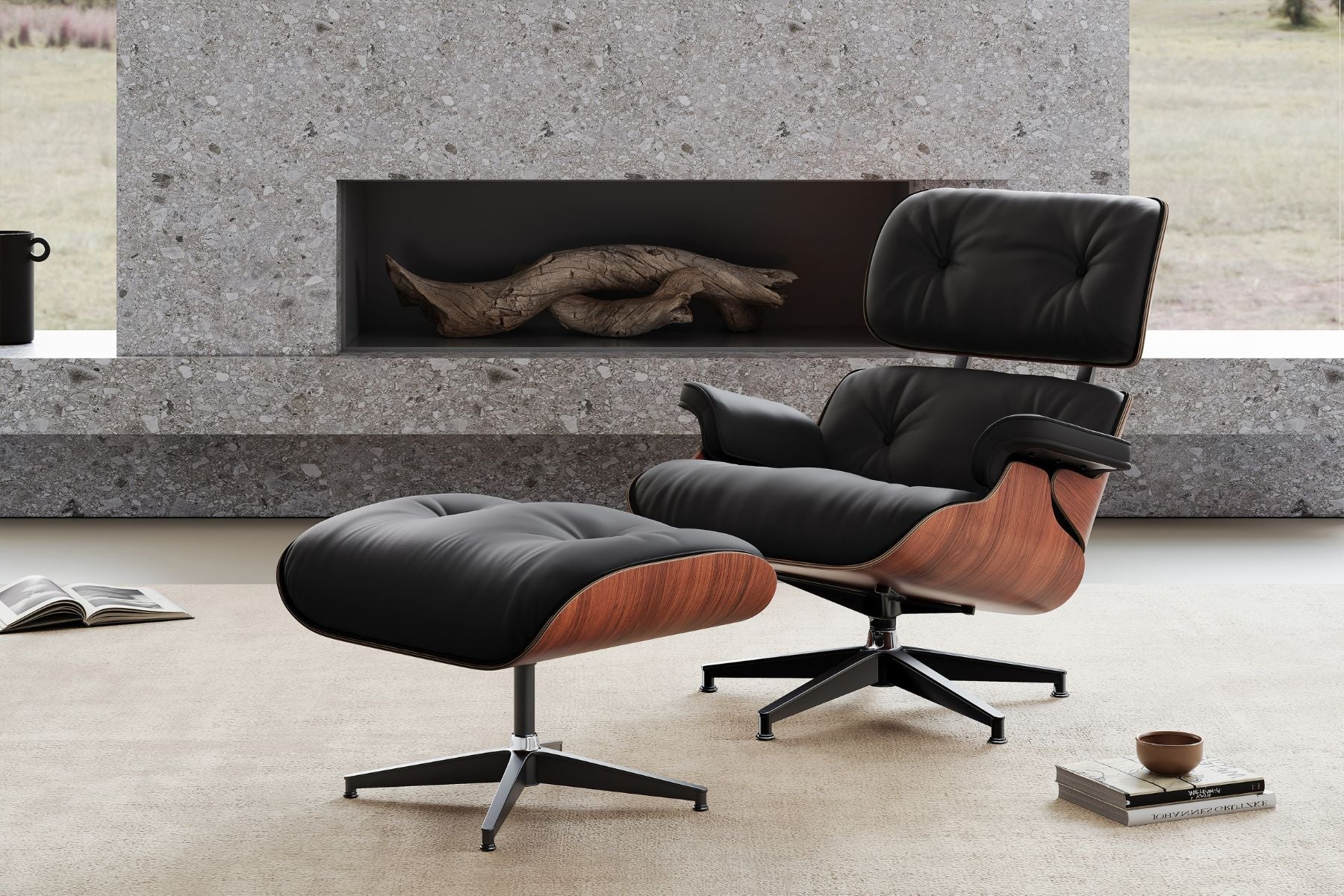
The Aria Leather Lounge Chair & Ottoman is a clean example of the club chair proportions — low seat, deep cushion, rounded arm — paired with a matching ottoman, which is a classic and practical companion piece for exactly this kind of low, settle-in chair.

Shown: Aria Leather Lounge Chair & Ottoman
Why Leather Is the Traditional Material
Leather isn't just historically accurate for a club chair — it's practically well suited to the role. A club chair is meant to be used often and for long stretches, and leather handles that kind of frequent contact better than most fabrics: it doesn't crush or mat the way a pile fabric can, it doesn't hold odors the way some woven fabrics do, and it develops a softened, slightly worn character over years of use that most people find appealing rather than a sign of wear. That aging quality is part of why leather club chairs from decades ago are still desirable rather than dated — the material improves with the exact kind of use a club chair is designed for. Not every club chair needs to be leather, but it's the material the silhouette was built around, and it's worth understanding why before choosing something else.
How to Style a Club Chair
Pair It With a Floor Lamp and Side Table
Because a club chair sits low and is built for staying a while, it pairs naturally with reading-focused elements: a floor lamp positioned just behind or beside the chair for direct overhead light, and a small side table within arm's reach for a book, a drink, or a phone. This combination turns a single chair into a complete, self-contained seating moment rather than just an extra chair in the room.
Use It as a Reading Nook Anchor
A club chair is one of the few pieces of furniture that can justify its own small zone within a larger room — a corner by a window, a spot near built-in shelving, or an underused nook that doesn't have enough square footage for a full seating group. Because the chair is self-contained and doesn't need to face a TV or coordinate with a sofa, it works well angled toward a window or a bookshelf rather than toward the room's main sightline.
The Tristan Leather Accent Chair is a good option for exactly this kind of anchor piece — a single, well-proportioned leather chair that can carry a corner of a room on its own.

Shown: Tristan Leather Accent Chair
Pair It With a Non-Matching Sofa
One of the most effective, low-effort styling moves in a living room is to deliberately not match the club chair to the sofa. A leather club chair next to a fabric sofa (or the reverse) creates visual contrast and signals that the room was curated piece by piece rather than bought as a single matching set. The key to making this work is keeping a shared thread somewhere — a similar tone family, a shared wood finish on the legs, or a complementary (not identical) color palette — so the contrast reads as intentional rather than mismatched.
Sizing a Club Chair for Your Room
Because club chairs sit low and deep, they take up more visual and physical footprint than their height suggests. Before buying, measure the intended spot with the chair's full footprint in mind, including enough clearance in front for someone to sit down and get up comfortably — club chairs are deep enough that a cramped approach in front of the chair makes the low seat harder to use, not just visually tight. If you're placing it as a pair (a common and effective use of club chairs, positioned facing each other or flanking a fireplace or window), make sure there's enough space between them and any center table for people to actually sit and hold a conversation, generally at least a few feet.
Frequently Asked Questions
What makes a chair a "club chair" specifically?
A club chair is defined by a low seat and back height, a deep seat for settling in, and rolled or track arms, tracing back to the leather-furnished gentlemen's clubs and libraries of early 20th-century Britain. It's a specific silhouette, not just any leather armchair.
What's the difference between a club chair and a wingback chair?
A club chair is low, open, and rounded, built for a relaxed, settled-in posture. A wingback chair is taller and more upright, with distinctive wing-shaped panels projecting from the sides of a high back, originally meant to block drafts and firelight near a fireplace. They come from a related design tradition but have opposite proportions.
Does a club chair have to be leather?
No, but leather is the traditional and historically accurate material for the silhouette, and it holds up especially well to the frequent, long-duration use a club chair is designed for — it resists crushing and matting better than many fabrics and develops an appealing worn-in character over time.
Where does a club chair work best in a room?
Club chairs work well as a self-contained reading or relaxing spot — paired with a floor lamp and side table, angled into an underused corner or window nook, or used as a non-matching companion to a sofa for visual contrast. They don't need to face a TV or match the room's main seating group.
Shop This Post
A well-chosen club chair can carry a whole corner of a room on its own. Explore Finn & Form's full accent chairs collection to find the right one for your space.


