

Inspiration

Japandi Style: Blending Japanese and Scandinavian Design in the Living Room
If one style has defined the interiors conversation over the past few years, it's Japandi. Google search interest in "japandi interior design" grew roughly 340% between 2020 and 2025, making it the most-searched AI interior design style heading into 2026 — and unlike a lot of design trends that peak and vanish, Japandi's popularity has kept climbing because it solves a real problem: how to make a minimalist room feel warm instead of empty. What Japandi Actually Is Japandi is a deliberate blend of two design traditions that, on paper, shouldn't fit together as neatly as they do: Japanese minimalism, with its emphasis on craft, negative space, and quiet materials, and Scandinavian function, with its focus on comfort, natural light, and everyday usability. The result is a style built on clean lines, honest natural materials, and a neutral palette punctuated with deep, earthy accent tones — think indigo, charcoal, and cedar rather than pastel or jewel tones. Where a lot of minimalist styles can feel sparse or unfinished, Japandi rooms feel resolved. Every piece is chosen deliberately, materials are left visible rather than covered up, and the overall effect is calm without being cold. The Core Principles of a Japandi Room Natural Materials, Left Honest Solid wood, not wood-look laminate. Woven textures, not printed patterns. Japandi rooms lean hard on materials that show their own grain and texture rather than trying to disguise what they're made of. A wood bed frame or table with visible joinery and natural grain does more for the style than any accessory could. A Neutral Base With Deep Accent Tones The palette starts neutral — warm white, oatmeal, soft grey — and then adds depth through a small number of darker, earthier accents: indigo textiles, charcoal ceramics, cedar-toned wood. The goal is contrast without clutter, so a room typically uses no more than two or three tones total. Function First, Decoration Second Scandinavian design's core belief — that a beautiful object should also work hard — shows up in Japandi through built-in storage, multi-purpose furniture, and a general resistance to purely decorative clutter. If a piece doesn't serve the room, Japandi doesn't have room for it. Building a Japandi Bedroom The bedroom is one of the easiest rooms to translate into Japandi, because the style's emphasis on calm and natural materials suits a space built for rest. A solid wood bed frame is the anchor piece — look for visible wood grain, a low profile, and joinery that doesn't hide behind upholstery or paint. Shown: Leroy Solid Wood Bed Frame The Leroy's solid wood construction and understated frame in walnut or white oak does exactly what a Japandi bedroom needs — a piece that reads as crafted rather than manufactured, with a low, grounded profile that keeps the room feeling calm rather than imposing. Bringing Japandi Into the Living Room The living room asks a bit more of the style, since it has to balance comfort with the same restraint that makes a bedroom feel calm. This is where texture does the heaviest lifting — a bouclé or textured fabric sofa in a neutral tone brings in the tactile warmth Japandi needs without introducing pattern or clutter. We covered this texture-first approach in more depth in our piece on bouclé furniture, and the overlap with Japandi is not a coincidence — both styles use tactile, honest materials to do the work that pattern and color would do in a busier room. Shown: Rodin 91" Fabric Modern Sofa A sofa like the Rodin, with its clean lines and quiet warm-white upholstery, works as a Japandi anchor because it doesn't fight for attention — it gives the room's wood tones and accent textiles room to be the story. Common Japandi Mistakes to Avoid The most common misstep is treating Japandi as pure Scandinavian minimalism and skipping the Japanese half entirely — that usually means too much stark white and not enough natural material depth. The second most common mistake is over-accessorizing: Japandi's negative space is intentional, and filling every surface with objects undoes the calm the style is built around. Keep accent tones to one or two per room, let wood grain and woven texture carry the visual interest, and resist adding a piece just because a surface looks empty. Start building your Japandi bedroom or living room from the ground up with the full Wood Beds collection. Frequently Asked Questions What's the difference between Japandi and Scandinavian design? Scandinavian design on its own tends to favor brighter, cooler whites and a lighter overall palette. Japandi pulls in Japanese design's emphasis on natural materials, craft, and deeper earth tones like indigo and cedar, giving the same functional, uncluttered bones a warmer, more grounded feel. Do I need matching wood tones throughout a Japandi room? No — exact matching isn't the goal. What matters more is keeping wood tones in the same general family (warm walnut vs. cool white oak, for example) so the room reads as cohesive rather than mismatched, even if individual pieces aren't identical. Can a small bedroom work in Japandi style? Japandi tends to suit small rooms particularly well, since the style's emphasis on negative space and a limited piece count naturally keeps a small room from feeling crowded. A low-profile solid wood bed frame and one or two functional pieces are usually enough. What accent colors work best in a Japandi room? Deep, earthy tones rather than bright or pastel ones — indigo, charcoal, and cedar are the most commonly used accents. The goal is one or two accent tones layered over a neutral base, not a full spectrum of color. Shop This Post Leroy Solid Wood Bed Frame From $1,218 Shop Now → Rodin 91" Fabric Modern Sofa From $999 Shop Now →
Learn more
Leather Loveseat Buying Guide
A loveseat is a small commitment with an outsized job: it usually sits in a spot that gets constant use — a den, a home office, a secondary seating area — and it has to earn that spot without the breathing room a full sofa gets. That combination of high use and limited scale is exactly why material choice matters so much on a loveseat, and it's a big part of why leather is such a strong fit for this particular piece of furniture. This guide focuses specifically on leather as a material for a loveseat: why it holds up, where a leather loveseat works best, and what to actually check before buying one. Why Leather Is a Strong Material Choice for a Loveseat Specifically Durability in a Smaller, High-Use Piece A loveseat often ends up in the highest-traffic seat in a house, precisely because of its size — it's the chair-that-seats-two in a home office, the extra seat in a den that gets used every evening, or the spot by a window that becomes someone's go-to. That concentrated use is hard on fabric, which can crush, pill, or show wear patterns in the seat cushions faster than people expect. Leather handles concentrated, repeated use differently: it doesn't pill, it resists the kind of visible wear patterns that flatten fabric pile, and it holds its shape under frequent sitting and rising. On a piece that's going to be sat on constantly rather than occasionally, that durability difference compounds over years. How Leather Ages This is one of the most practical advantages leather has over fabric on a smaller, heavily used piece: it ages by developing a softened, slightly burnished character rather than by visibly wearing out. A fabric loveseat used daily for several years often starts to look tired — matted pile, faded high-contact areas, a general softness that reads as worn rather than settled. Leather used the same way tends to develop a gentle patina instead, particularly at the arms and seat where hands and weight make the most contact, and most people find that look appealing rather than a sign the piece needs replacing. That's a meaningful difference on a loveseat, which by nature of its size gets more concentrated contact per square foot than a larger sofa. Cleaning Ease Because a loveseat frequently does double duty as an everyday seat — morning coffee, a lunch break at the home office, kids or pets passing through — day-to-day spills and marks are a real consideration. Leather is simple to wipe down with a slightly damp cloth for most everyday marks, without the deeper cleaning or professional treatment that a spill can require on fabric upholstery. That ease of maintenance matters more, not less, on a smaller piece that's in constant rotation. Style Versatility Leather also does a lot of styling work on a small piece of furniture. A loveseat has less surface area than a sofa to make a visual statement, and leather's clean, substantial look reads as intentional and grounded even in a compact footprint — it doesn't need a pattern or a particular color story to feel finished the way some fabrics do. That makes a leather loveseat easier to place in a room that already has other, larger pieces with their own personality, since leather tends to complement rather than compete. The Brun Leather Sofa with Adjustable Headrest is available in a 74-inch loveseat-length configuration, which is a useful example of a compact-format leather piece built with the same details — including the adjustable headrest — as its larger sofa counterpart. Shown: Brun Leather Sofa with Adjustable Headrest Where a Leather Loveseat Works Best A leather loveseat tends to earn its keep in a handful of specific spots. In a den, it's often the everyday seat rather than the occasional-guest seat, which plays directly to leather's durability advantage. In a home office, a loveseat gives a spot for a quick call, a reading break, or a second person to sit without dedicating the square footage a full sofa would need — and leather's easy cleanup matters here too, given how much daily contact a home-office seat gets. As secondary living room seating, a loveseat rounds out a seating group without duplicating the main sofa, often positioned perpendicular to it or facing it across a coffee table. And paired with a sectional, a loveseat can add flexible extra seating for a larger gathering while still functioning as a smaller, standalone piece the rest of the time — useful in a room that needs to flex between an everyday footprint and an occasional larger one. The Vidal Leather Sofa is a good reference point for how the same design language scales between a full sofa and a smaller-format piece, and it's worth looking at directly alongside a loveseat-length option to compare proportions for your space. Shown: Vidal Leather Sofa What to Check When Buying a Leather Loveseat Grain Quality Leather grade affects how a loveseat looks and wears over time. Leather that retains more of its natural grain tends to age with more character and stays supple longer, while heavily corrected or thickly coated leather can look more uniform out of the box but is more prone to visible wear at high-contact points over time. Ask what grade of leather is used, and where on the piece it's applied, since many manufacturers reserve the higher grade for the seating surfaces that see the most contact. Frame Construction A loveseat's frame does the same structural job as a larger sofa's frame but in a smaller footprint, which means every joint and support point matters proportionally more. A solid, well-built frame is the single biggest factor in whether a loveseat holds its shape and stays quiet (no creaking) after years of regular use. This is harder to evaluate from a listing alone, but weight, joinery description, and warranty terms are reasonable proxies for construction quality. Cushion Fill Cushion fill affects both immediate comfort and how the loveseat holds up over time. Higher-density foam, sometimes wrapped in down or a down-alternative fiber, tends to hold its shape better under repeated daily use than lower-density foam alone, which can flatten and lose support faster on a piece that's sat on constantly. Given how much use a loveseat typically gets relative to its size, cushion fill quality is worth asking about directly rather than assuming. Frequently Asked Questions Why is leather a good choice specifically for a loveseat rather than a full sofa? A loveseat often sees more concentrated, everyday use per square foot than a larger sofa, since it's frequently the go-to seat in a den, home office, or secondary living area. Leather holds up better than fabric under that kind of repeated contact — it resists pilling and visible wear patterns, ages by developing character rather than looking worn out, and wipes clean easily, all of which matter more on a smaller piece in constant rotation. Where does a leather loveseat work best in a home? Common spots include a den (as the everyday seat), a home office (for calls, breaks, or a second seat without using much floor space), as secondary seating in a living room alongside a main sofa, and paired with a sectional to add flexible extra seating for larger gatherings. What should I check before buying a leather loveseat? Three things matter most: the grain quality of the leather (more natural grain generally ages better and stays more supple), the frame construction (a solid frame matters proportionally more on a smaller piece), and the cushion fill (higher-density foam holds its shape better under the frequent use a loveseat typically gets). Does a leather loveseat need more maintenance than a fabric one? No — if anything, day-to-day maintenance is simpler. Leather can be wiped down with a slightly damp cloth for most everyday marks, without the deeper cleaning fabric upholstery often needs after a spill. Periodic conditioning keeps the leather supple over the long term, but routine care is straightforward. Shop This Post Brun Leather Sofa with Adjustable Headrest From $1,995 Shop Now → Vidal Leather Sofa From $2,925 Shop Now → A leather loveseat is a small piece that carries a lot of daily use, and choosing the right one pays off for years. Browse Finn & Form's loveseat collection to find the right fit for your space.
Learn more
Warm Minimalism: The Design Trend Replacing Stark Minimalism
For most of the last decade, minimalism meant restraint bordering on austerity: white walls, glass and chrome, rooms so pared-back they photographed beautifully and felt cold to actually live in. That era is fading. The design conversation heading into 2026 has shifted decisively toward what stylists and design publications are now calling warm minimalism — the same disciplined, uncluttered bones as classic minimalism, but rebuilt in a palette and material language that feels inhabited rather than staged. What Is Warm Minimalism? Warm minimalism keeps minimalism's core discipline — few pieces, clean lines, no visual noise — but swaps out the cold foundation. Instead of stark white walls and glossy black-and-chrome furniture, the palette moves toward warm white, cream, sand, oatmeal, and taupe as a base, layered with richer accent tones like camel, terracotta, olive green, soft clay, and warm blush. The silhouettes stay simple. The materials and colors do the emotional work that ornament used to do. It shares a lot of DNA with Japandi, the Japanese-Scandinavian hybrid style that has become the most-searched interior style of the past few years — both reject clutter and maximalist decoration in favor of function and craft. But where Japandi leans toward a cooler, more austere natural palette, warm minimalism is explicitly about softness: rounded edges, tactile fabrics, and colors pulled from clay, sand, and wood rather than stone and steel. Why Stark Minimalism Is Losing Its Grip The broader shift happening across interiors right now is a move away from cold, showroom-perfect spaces toward rooms that feel warm, intentional, and personal. Stark minimalism photographed well for a decade of design blogs, but it never quite worked as a place to actually live — hard surfaces, sparse seating, and a palette with no warmth in it. Homeowners furnishing rooms today are asking a different question than they did five years ago: not "how little can this room contain," but "how does this room feel to sit in at the end of a long day." Warm minimalism is the answer design has landed on. It keeps the editing discipline of minimalism — no clutter, no excess pieces — while making sure every piece that stays earns its place through comfort and material warmth, not just visual restraint. The Warm Minimalist Palette, Piece by Piece Building a warm minimalist room starts with a neutral foundation — walls, rugs, and large upholstery in warm white, cream, or sand — and then layering in one or two deeper accent tones through smaller pieces, cushions, and wood finishes. The goal is depth without visual clutter: a room with three or four tonal notes reads as calm and considered, where a room with one flat neutral reads as unfinished. Anchor the Room in a Quiet, Warm-Toned Sofa A sofa is the single largest surface in most living rooms, which makes it the piece that sets the tone for everything else. In a warm minimalist room, that means choosing an upholstery color from the cream-to-sand family rather than cool white or grey, and a silhouette that's clean without being severe — no ornate skirting, no busy tufting, just honest proportions and a soft hand-feel fabric. Shown: Rodin 91" Fabric Modern Sofa The Rodin's wide, low-profile seat and serene white fabric do exactly this — a sofa quiet enough to sit at the center of a warm minimalist room without competing with the rest of the palette, but substantial enough that the room doesn't feel under-furnished. Texture Over Ornament With decoration stripped back, texture becomes the main way a warm minimalist room avoids feeling flat. This is where the philosophy overlaps with the idea we've written about before in sensible luxury — investing in fewer, better pieces whose materials carry the room instead of trying to fill space with quantity. A bouclé throw, a wood coffee table with visible grain, a woven basket for storage — these add depth without adding clutter, which is the entire point of the style. Where Leather Still Belongs in a Warm Room Leather might seem like an unlikely fit for a soft, warm-toned room, but a rich, deep-toned leather piece actually does a lot of the same work as a terracotta or clay accent — it adds warmth and material contrast against a neutral backdrop without introducing pattern or clutter. Shown: Brun Leather Sectional Sofa with Adjustable Headrest The Brun, wrapped in Nordic Hygge™ Leather in a deep dark brown, works as an anchor piece in a warm minimalist den or family room — its low-slung profile and adjustable headrest keep the silhouette clean, while the leather's natural grain and patina give the room the tactile richness that a flatter fabric can't. Building the Room, Not Just the Palette The easiest way to overcomplicate warm minimalism is to treat it as a color trend and stop there. It's really a discipline: pick fewer pieces, choose warmer neutrals and one or two honest accent tones, and let materials — wood grain, leather, bouclé, woven textures — carry the visual interest that pattern and ornament used to carry. Start with the largest piece in the room, keep the palette to a warm neutral base plus a single deeper accent, and resist the urge to add a piece just to fill a corner. If it doesn't add warmth or function, it's working against the room rather than for it. Ready to start building? Browse the full Living Room collection for warm-toned sofas, sectionals, and chairs that fit the palette. Frequently Asked Questions What's the difference between warm minimalism and Japandi? They share the same minimalist discipline — few pieces, clean lines, no clutter — but warm minimalism uses a softer, more saturated palette (cream, terracotta, clay, blush) while Japandi leans on a cooler, more restrained natural palette rooted in Japanese and Scandinavian craft traditions. Is warm minimalism the same as boho or maximalism? No. Warm minimalism keeps the editing discipline of minimalism — a limited number of pieces and no visual clutter. It just replaces cold whites and greys with warmer neutrals and richer accent tones, rather than adding pattern, layering, or collected objects the way boho or maximalist styles do. How do I make my current sofa fit a warm minimalist room? If your existing sofa is a cool white or grey, the easiest fix is to warm up everything around it — a cream or sand rug, wood furniture with visible grain, and cushions in terracotta or olive tones. If you're replacing the sofa itself, choose an upholstery color from the cream-to-sand family over a stark white or cool grey. Does warm minimalism work in a small living room? It often works better in a small room than a busier style would, since the reduced piece count keeps the space feeling open. Choose one clean-lined anchor sofa or sectional in a warm neutral, add a single leather or wood accent piece, and avoid overcrowding the room with extra furniture. Shop This Post Rodin 91" Fabric Modern Sofa From $999 Shop Now → Brun Leather Sectional Sofa with Adjustable Headrest From $2,655 Shop Now →
Learn more
Club Chair 101: What It Is and How to Style One
"Club chair" is one of those furniture terms that gets used loosely, often to describe almost any leather armchair. But a true club chair has a specific silhouette and a specific history, and knowing what actually defines one makes it much easier to shop for the real thing — and to style it so it reads as intentional rather than just "a chair we had." Here's what makes a club chair a club chair, how it differs from other common chair types, and how to place one well in a room. What Actually Defines a Club Chair The club chair traces back to the leather-furnished gentlemen's clubs and libraries of early 20th-century Britain and the smoking-room furniture of that era — low, deep, upholstered leather chairs built for sitting back and staying a while, not for perching upright. That origin still defines the silhouette today. A genuine club chair is typically: Low to the ground, with a seat height and back height noticeably lower than a standard armchair, encouraging a relaxed, settled-in posture rather than an upright one. Deep-seated, with enough seat depth to sit back fully rather than perch on the edge. Rolled or track arms, meaning the arms either curve outward in a rounded roll (the more traditional look) or run in a straighter, more architectural line (a more contemporary "track arm" take on the same basic shape). Traditionally upholstered in leather, which was both a practical and a status choice in the original clubs — leather held up to heavy daily use in a shared space and aged well over years of exactly that kind of use. None of this is arbitrary styling — each element traces back to a chair meant to be sat in for hours, in a room full of other people doing the same thing. Club Chair vs. Accent Chair vs. Wingback These three get confused constantly, so it's worth being precise. An accent chair is a broad, catch-all category — essentially any chair chosen to add visual interest or a design accent to a room, in any silhouette, fabric, or era. Every club chair is technically an accent chair, but not every accent chair is a club chair. A wingback chair is a specific competing silhouette from the same general design lineage: tall, with distinctive "wings" projecting forward from the sides of the high back, originally designed to block drafts and firelight from the sides of a person's face when seated near a fireplace. Wingbacks sit taller and more upright than club chairs, and their defining feature (the wings) is the opposite design instinct from a club chair's low, open, rounded profile. A club chair, by contrast, is low, open, and rounded, with nothing framing the sides of the head. If you want a chair that reads as a relaxed, settle-in seat, a club chair is the more natural choice. If you want something more formal and architectural with a distinct traditional silhouette, a wingback fits that role instead. The Aria Leather Lounge Chair & Ottoman is a clean example of the club chair proportions — low seat, deep cushion, rounded arm — paired with a matching ottoman, which is a classic and practical companion piece for exactly this kind of low, settle-in chair. Shown: Aria Leather Lounge Chair & Ottoman Why Leather Is the Traditional Material Leather isn't just historically accurate for a club chair — it's practically well suited to the role. A club chair is meant to be used often and for long stretches, and leather handles that kind of frequent contact better than most fabrics: it doesn't crush or mat the way a pile fabric can, it doesn't hold odors the way some woven fabrics do, and it develops a softened, slightly worn character over years of use that most people find appealing rather than a sign of wear. That aging quality is part of why leather club chairs from decades ago are still desirable rather than dated — the material improves with the exact kind of use a club chair is designed for. Not every club chair needs to be leather, but it's the material the silhouette was built around, and it's worth understanding why before choosing something else. How to Style a Club Chair Pair It With a Floor Lamp and Side Table Because a club chair sits low and is built for staying a while, it pairs naturally with reading-focused elements: a floor lamp positioned just behind or beside the chair for direct overhead light, and a small side table within arm's reach for a book, a drink, or a phone. This combination turns a single chair into a complete, self-contained seating moment rather than just an extra chair in the room. Use It as a Reading Nook Anchor A club chair is one of the few pieces of furniture that can justify its own small zone within a larger room — a corner by a window, a spot near built-in shelving, or an underused nook that doesn't have enough square footage for a full seating group. Because the chair is self-contained and doesn't need to face a TV or coordinate with a sofa, it works well angled toward a window or a bookshelf rather than toward the room's main sightline. The Tristan Leather Accent Chair is a good option for exactly this kind of anchor piece — a single, well-proportioned leather chair that can carry a corner of a room on its own. Shown: Tristan Leather Accent Chair Pair It With a Non-Matching Sofa One of the most effective, low-effort styling moves in a living room is to deliberately not match the club chair to the sofa. A leather club chair next to a fabric sofa (or the reverse) creates visual contrast and signals that the room was curated piece by piece rather than bought as a single matching set. The key to making this work is keeping a shared thread somewhere — a similar tone family, a shared wood finish on the legs, or a complementary (not identical) color palette — so the contrast reads as intentional rather than mismatched. Sizing a Club Chair for Your Room Because club chairs sit low and deep, they take up more visual and physical footprint than their height suggests. Before buying, measure the intended spot with the chair's full footprint in mind, including enough clearance in front for someone to sit down and get up comfortably — club chairs are deep enough that a cramped approach in front of the chair makes the low seat harder to use, not just visually tight. If you're placing it as a pair (a common and effective use of club chairs, positioned facing each other or flanking a fireplace or window), make sure there's enough space between them and any center table for people to actually sit and hold a conversation, generally at least a few feet. Frequently Asked Questions What makes a chair a "club chair" specifically? A club chair is defined by a low seat and back height, a deep seat for settling in, and rolled or track arms, tracing back to the leather-furnished gentlemen's clubs and libraries of early 20th-century Britain. It's a specific silhouette, not just any leather armchair. What's the difference between a club chair and a wingback chair? A club chair is low, open, and rounded, built for a relaxed, settled-in posture. A wingback chair is taller and more upright, with distinctive wing-shaped panels projecting from the sides of a high back, originally meant to block drafts and firelight near a fireplace. They come from a related design tradition but have opposite proportions. Does a club chair have to be leather? No, but leather is the traditional and historically accurate material for the silhouette, and it holds up especially well to the frequent, long-duration use a club chair is designed for — it resists crushing and matting better than many fabrics and develops an appealing worn-in character over time. Where does a club chair work best in a room? Club chairs work well as a self-contained reading or relaxing spot — paired with a floor lamp and side table, angled into an underused corner or window nook, or used as a non-matching companion to a sofa for visual contrast. They don't need to face a TV or match the room's main seating group. Shop This Post Aria Leather Lounge Chair & Ottoman From $1,079 Shop Now → Tristan Leather Accent Chair From $1,254 Shop Now → A well-chosen club chair can carry a whole corner of a room on its own. Explore Finn & Form's full accent chairs collection to find the right one for your space.
Learn more
Leather Recliner Buying Guide: What to Know Before You Buy
A good recliner earns its place in a room by disappearing into daily life — it's where you land after work, where you read on a Sunday, where a nap happens without anyone planning it. Leather makes that piece last, and it makes it look intentional rather than like a concession to comfort. But "leather recliner" covers a wide range of construction, mechanisms, and price points, and the differences matter more here than on almost any other upholstered piece, because a recliner has moving parts that leather has to survive. This guide walks through what actually separates a recliner worth buying from one you'll regret in three years. Why Leather Quality Matters More on a Recliner Every recliner mechanism, whether manual or power, asks the upholstery to flex repeatedly at the same seams — across the back-to-seat junction, around the footrest, and at the arm panels. A sofa cushion gets sat on; a recliner's leather gets folded and unfolded, day after day, for years. That's the single biggest reason leather grade matters more here than on a stationary chair or sofa. Lower-grade leather, or leather that's been heavily corrected and coated to hide imperfections, tends to crack or peel at exactly those flex points first. Higher-grade leather with more of its natural grain intact keeps its flexibility over time because the fiber structure hasn't been sanded away and buried under a thick pigmented coating. When you're comparing recliners, ask what grade of leather is used and where it's applied — many brands use full leather only on the seating surfaces (seat, back, arms) and a leather-look vinyl or split leather on the back and sides, which is a reasonable cost-saving approach as long as it's disclosed, since those areas don't take the wear or the flexing that the seating surfaces do. Manual vs. Power Recline The most basic decision in any recliner purchase is mechanism type, and it affects price, ease of use, and long-term maintenance. Manual Recline A manual recliner uses a side handle, lever, or a push-back mechanism you activate with your body weight. There's nothing to plug in, nothing to charge, and nothing electronic to eventually need service. Manual mechanisms are mechanically simple, which generally makes them more affordable and, over a long ownership period, less likely to need a repair. The tradeoff is that reclining takes a bit more physical effort and the recline position is usually less finely adjustable — you get a few fixed positions rather than a continuous range. Power Recline A power recliner uses a motor to move the footrest and backrest, typically controlled with a button or small remote. Power mechanisms let you stop at any position along the recline range, which is a real comfort advantage, and many power recliners also lower the effort needed to get in and out of a fully reclined position, since you're not pushing against the mechanism yourself. The Ozanne Leather Power Recliner Chair is a straightforward example of a single-seat power recliner built for this kind of everyday use. Shown: Ozanne Leather Power Recliner Chair Power recliners need to be near an outlet (most use a standard plug, not a hardwired connection), and because they involve a motor and control unit, there's a bit more that could eventually need attention compared with a purely mechanical manual recliner. For most households, that tradeoff is well worth it for the convenience. Recliner Chair vs. Reclining Sofa or Sectional The other major decision is scale: do you want a single recliner chair, or a full reclining sofa (or sectional) where multiple seats each recline independently? A single recliner chair, like the Ozanne, works well as a dedicated spot — a reading chair, a chair paired with a console for gaming or TV, or an accent seat that doesn't need to match the rest of the room's seating exactly. It's also the more flexible purchase if you're not sure how a room's layout will evolve, since a single chair is easy to reposition or move to another room entirely. A reclining sofa, like the Bain Leather Power Reclining Sofa, extends the same idea across a full seating run, with each section able to recline on its own. That means multiple people can watch a movie, read, or relax at the same time, each in their own recline position, without needing separate chairs scattered around the room. It's the better choice for a primary living room or media room seating arrangement, especially for a household of more than one or two people. Shown: Bain Leather Power Reclining Sofa Reclining sectionals take this further, wrapping reclining seats around a corner to fill a larger room while still giving every seat its own recline function. The right choice comes down to room size and how many people regularly use the space at once. Sizing and Clearance: Wall-Hugger vs. Standard Mechanism One of the most overlooked parts of buying a recliner is what happens behind it when it opens. This is where the distinction between a "wall-hugger" (or wall-saver) mechanism and a standard mechanism becomes genuinely practical, not just a spec sheet detail. A standard recliner mechanism reclines by sliding the entire chair back on its base as the footrest extends and the back drops — the chair essentially moves backward into the room as it opens. That means a standard recliner needs several inches to a couple of feet of open space behind it, depending on the design, or it will strike the wall before it can fully recline. A wall-hugger mechanism is engineered differently: as the footrest extends, the seat itself slides slightly forward on the base rather than the whole chair moving backward, so the back of the chair stays close to the wall throughout the recline motion. This lets a wall-hugger recliner sit just a few inches from a wall and still fully recline, which is a meaningful advantage in smaller rooms, apartments, or any spot where the chair's back is close to a wall. Before buying any recliner, measure the actual space behind where it will sit, and check whether the mechanism is described as wall-hugger/wall-saver or standard. If you're working with a tight room, a wall-hugger design removes a common source of frustration after delivery. Swivel and Rocking Recliner Variants Beyond the basic recline function, many recliners add a secondary motion. A swivel recliner rotates on its base, which is useful in a room where the chair needs to face different directions at different times — toward a TV in the evening, toward a conversation area during the day. A rocking recliner (sometimes called a glider or rocker recliner) adds a gentle back-and-forth rocking motion independent of the recline function, which many people find soothing for everyday relaxing, not just for a nursery. Some recliners combine swivel, rocking, and reclining motion in a single chair. These are worth considering if you want the seat to do more than recline in place, though it's a preference rather than a requirement — plenty of households are perfectly happy with a chair that simply reclines. Caring for a Leather Recliner Leather recliner maintenance isn't complicated, but a little consistency goes a long way given how much flexing the material does. Dust and vacuum the seams and crevices around the recline mechanism periodically, since dirt trapped in a fold is what accelerates wear at exactly the point that's already under the most stress. Wipe the leather down with a soft, slightly damp cloth as needed, and use a leather conditioner every few months to keep the material supple — dry leather is what cracks, and conditioning is the simplest way to prevent that, especially near the flex points at the back-to-seat seam. Keep the chair out of direct, prolonged sunlight where possible, since UV exposure dries out and fades leather over time. And avoid placing the chair somewhere its motor cord will be under tension or crimped, since that's an easy way to create an electrical problem that has nothing to do with the leather itself. Frequently Asked Questions Is a power recliner worth the extra cost over a manual one? For most people, yes. A power recliner lets you stop at any point in the recline range rather than a few fixed positions, and it takes less physical effort to operate, which matters over years of daily use. The tradeoff is that a power recliner needs to be near an outlet and has a motor and control unit that a manual mechanism doesn't. How do I know if I need a wall-hugger recliner? Measure the space between where the chair's back will sit and the nearest wall. A standard mechanism needs several inches to a couple of feet of clearance to fully recline, because the whole chair slides backward as it opens. If your space is tighter than that, look specifically for a wall-hugger (or wall-saver) mechanism, which slides the seat forward instead of the chair backward, so it can sit close to a wall and still fully recline. What's the difference between a recliner chair and a reclining sofa? A recliner chair is a single seat, useful as a dedicated reading or TV chair and easy to reposition in a room. A reclining sofa extends the same recline function across a full seating run, with each section reclining independently, which works better as primary seating for a household of more than one or two people who want to relax at the same time. How often should I condition leather on a recliner? Every few months is a reasonable baseline, though it can depend on your home's humidity and how often the chair is used. The goal is to keep the leather supple, particularly around the seams where the mechanism folds the material repeatedly, since dry leather is what eventually cracks at those flex points. Shop This Post Ozanne Leather Power Recliner Chair From $1,500 Shop Now → Bain Leather Power Reclining Sofa From $3,252 Shop Now → Whether you're outfitting a single reading corner or a full media room, the right leather recliner comes down to matching the mechanism, size, and leather grade to how you'll actually use it. Browse Finn & Form's full living room collection to see the range in person.
Learn more
Swivel Chair Benefits: Why This Small Upgrade Makes a Big Difference
A swivel chair sounds like a small feature — a chair that rotates 360 degrees instead of staying fixed in one direction. In practice, that single feature changes how a room can be used far more than its size would suggest. Here's why it's worth considering, and where it makes the most sense. The Practical Benefit: One Chair, More Than One View A fixed chair or sofa faces one direction, permanently, unless you physically move it. A swivel chair removes that constraint entirely — you can turn to face a conversation, pivot toward a window view, or rotate toward the TV, all without repositioning the furniture itself. In a room that gets used for more than one purpose throughout the day, that flexibility is genuinely useful rather than a novelty. It means the room can adapt to what you're doing in the moment instead of you adapting to how the furniture happens to be arranged. Where Swivel Chairs Work Especially Well Swivel chairs earn their keep most in rooms that serve double duty. A living room that also functions as a reading nook is a good example: face the chair toward the sofa for conversation during the day, then turn it toward a window or a reading lamp in the evening. A chair placed near a window benefits from the same flexibility — turned outward, it's a spot to sit and look outside; turned back toward the room, it rejoins the seating arrangement without ever needing to be dragged across the floor. Shown: Auclair Bouclé Fabric 360° Swivel Chair Pairing a Swivel Chair With Fixed Seating One of the more underrated uses of a swivel chair is pairing it with a sofa or sectional that stays put. Rather than trying to build an entire seating arrangement out of pieces that all need to be repositioned for different activities, a fixed sofa can anchor the room while one or two swivel chairs flex around it — angled toward the sofa for a conversation, turned toward the TV for movie night, or rotated toward a game table for cards. It gives a room real flexibility without asking you to rearrange heavy furniture every time the use of the room changes. Paired with a substantial anchor piece like the Maestro 3 Seater Leather Sofa, a single swivel chair can flex between facing the sofa for conversation and facing the TV or a window, all without moving the sofa itself. Material and Style Options Swivel chairs come in enough materials and finishes that the feature doesn't lock you into one look. A bouclé swivel chair like the Auclair brings texture into a room, which is especially useful in a space with a lot of flat, neutral surfaces — it adds visual interest without adding another color to manage. A leather swivel base combines the rotation with the easy-care, long-wearing character of leather, which suits a chair meant to handle daily use rather than occasional lounging. A fabric swivel chair opens up the widest range of color options, which makes it a natural fit if the chair is meant to be an accent piece rather than a neutral supporting player in the room. Maintenance Is About the Material, Not the Swivel It's worth clearing up a common assumption: the swivel mechanism itself isn't a maintenance concern. A well-built swivel base is a simple, low-maintenance mechanical feature, no different in upkeep from the legs on any other chair. What actually determines how much care a swivel chair needs is the upholstery material chosen, exactly the same as it would be for a stationary chair — leather needs occasional conditioning, fabric benefits from regular vacuuming and prompt attention to spills, and bouclé should be treated the way any textured woven fabric would be. Choosing to swivel or not doesn't change any of that. A Few Placement Tips Worth Knowing Because a swivel chair depends on being able to actually rotate, it needs a bit more clearance around it than a fixed chair would in the same spot. Leaving enough open floor space on at least two or three sides lets the chair turn freely without bumping a side table or a lamp mid-rotation. It is also worth thinking about the two or three positions you expect to use most often, rather than treating the 360-degree range as something you will use constantly. Most people settle into a couple of favorite orientations, so it helps to make sure the chair looks and feels right in those specific positions, not just in the one it happens to be photographed in. Is a Swivel Chair Right for Your Room? If your living space serves more than one purpose, or if you have a chair positioned near a window, a fireplace, or a TV that competes for attention with the rest of the room, a swivel base solves a real problem rather than adding an unnecessary feature. It's a small mechanical difference that ends up affecting how naturally a room flows from one activity to the next. Frequently Asked Questions Does a swivel chair need to be positioned against a wall? No — in fact, a swivel chair works best with clearance on multiple sides so it can rotate freely. Positioning it a foot or more away from walls and neighboring furniture keeps the full range of motion usable. Are swivel chairs less stable than fixed chairs? A well-built swivel base is engineered to support the chair's full weight capacity just as securely as a fixed base; the mechanism only affects rotation, not stability while seated. Can a swivel chair replace a recliner? Not necessarily — swivel and reclining are two separate mechanical features. Some chairs combine both, but a standard swivel chair rotates without reclining, so if lounging with your feet up is the priority, check whether the specific model also offers a reclining function. What upholstery is easiest to maintain on a swivel chair? Leather and performance fabrics are generally the lowest-maintenance choices, since they resist stains and wipe clean easily. Textured fabrics like bouclé look and feel great but benefit from a bit more regular care, the same as they would on any stationary chair. Shop This Post Auclair Bouclé Fabric 360° Swivel Chair From $879 Shop Now → Maestro 3 Seater Leather Sofa From $1,509 Shop Now → Explore Finn & Form's swivel chair collection to find a piece — in bouclé, leather, or fabric — built to move with the way you actually use the room.
Learn more
The Best Sectional Sofas for Small Apartments
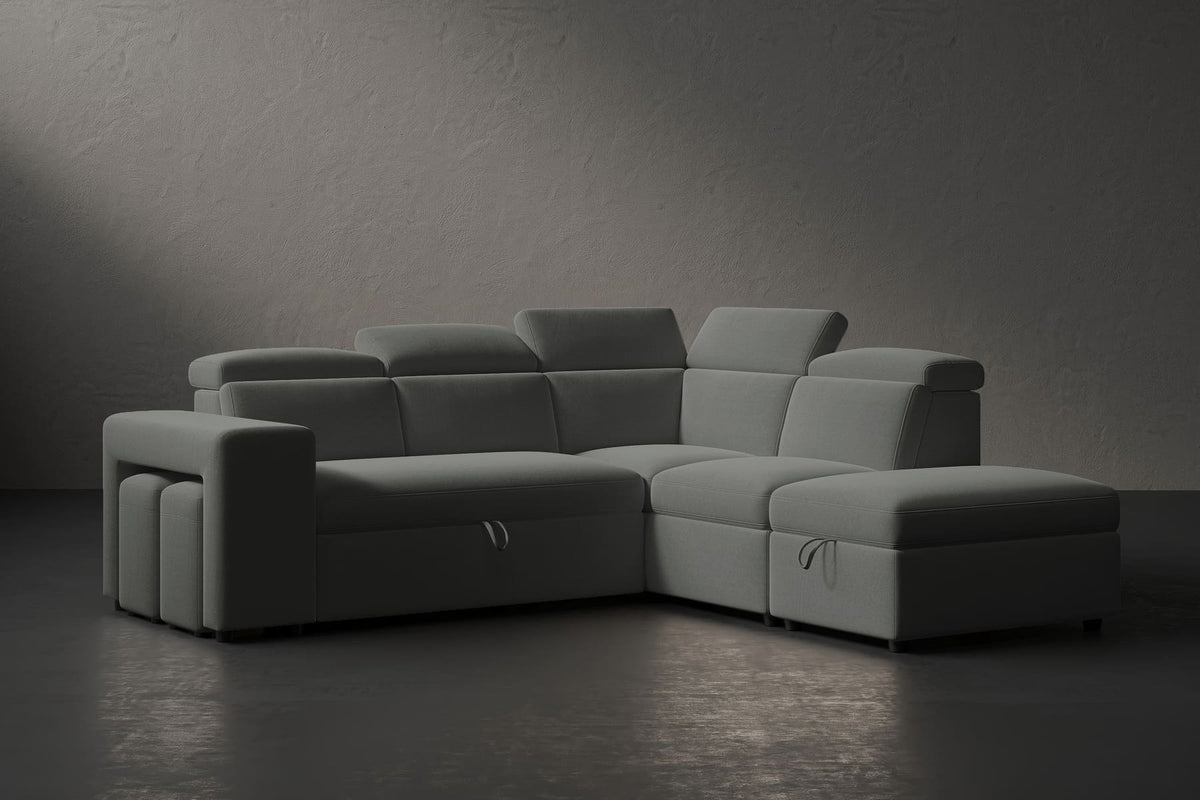
The assumption that a small apartment can't fit a sectional sofa is one of the most common furniture-shopping myths out there, and it's usually backwards. A well-scaled sectional sofa for a small apartment can actually use the space more efficiently than two separate pieces — a sofa plus an armchair, say — because it claims a single footprint instead of two, and it can be shaped to work with the room's layout rather than fighting it. Here's how to choose one that genuinely fits. Why a Sectional Can Work Harder Than Separate Pieces In a small living room, corners are almost always underused. A standalone sofa and chair combination typically floats in the middle of the room or lines up along one wall, leaving the corners as dead space that's awkward to furnish and easy to ignore. A sectional with a corner-hugging chaise does the opposite: it tucks its longest arm directly into the corner, using that otherwise-wasted square footage as functional seating instead of empty floor. One Footprint Instead of Two Because a sectional is one connected piece, it also avoids the visual clutter of navigating around multiple furniture legs and gaps that separate pieces create. A small room reads as more open when there's a single, continuous line of seating along one side, rather than several smaller items scattered with sightlines broken up between them. Measure Before You Buy — Including the Path There This is the step that causes the most regret after a sectional purchase, and it has nothing to do with the couch fitting the room. It has to do with the couch fitting through the door. Measure the Final Placement First Start with the basics: measure the wall length and depth where the sectional will sit, and make sure there's still walking clearance — ideally at least 30 inches — between the sectional and any coffee table, TV console, or walkway through the room. It's easy to size a sectional to the empty floor plan and forget that people still need to move around it once it's in place. Then Measure Every Doorway, Hallway, and Stairwell Before you finalize an order, measure every doorway, hallway turn, elevator interior, and stairwell the sectional will need to pass through to reach its final spot — not just the front door width, but the tightest turn along the entire route. Many sectionals ship in separate sections specifically so each piece can be maneuvered through tighter apartment doorways individually, but it's still worth confirming the dimensions of each section against your building's actual access points before ordering, especially in older buildings with narrow stairwells or tight hallway turns. Choose a Lower-Profile or Reversible Chaise Two design details make an outsized difference in how "big" a sectional feels in a small room: arm height and chaise flexibility. Lower-Profile Arms and Backs A sectional with a lower back and slimmer arms takes up less visual height, which keeps sightlines open across the room and prevents the piece from dominating a smaller space the way a tall, boxy silhouette can. This matters more in a small apartment than it would in a larger living room, where a taller-profile sofa has more surrounding space to balance against. Reversible Chaise for Layout Flexibility A reversible or modular chaise configuration means the sectional isn't locked into one specific room layout. If you move apartments, or simply want to try the piece against a different wall, a reversible chaise can switch sides without buying new furniture — a genuinely practical feature for anyone renting or expecting to move again within a few years. Shown: Rodin 94.5" Fabric Sectional Sofa Color and Fabric Choices That Keep a Small Room Open Beyond dimensions, the color and material of a sectional sofa affects how large a small room feels once it's furnished. Lighter Tones Read as More Open A lighter fabric or leather tone — cream, taupe, light grey — reflects more light and creates less visual weight than a dark saturated color, which helps a small room feel less closed-in. This doesn't mean a dark sectional can't work in a small apartment, but it's worth being intentional about it: a deep charcoal or black sectional will read as a much heavier visual anchor in a compact room than the same silhouette in a lighter shade. Avoid Bulky, Heavily Textured Upholstery A smooth leather or a tightly woven performance fabric tends to keep a sectional looking sleeker and less visually heavy than a deeply textured, high-pile fabric, which can make the same piece of furniture look bulkier than its actual dimensions. In a small apartment, that visual weight matters — a leather sectional with clean lines can make a corner feel considered rather than crowded. Shown: Maestro Leather Corner Sectional Sofa Frequently Asked Questions Can a sectional sofa actually fit in a small apartment? Yes. A well-scaled sectional can use space more efficiently than separate pieces because it claims one footprint and can tuck a chaise into an otherwise-wasted corner. What should I measure before buying a sectional? Measure the wall length and depth for final placement with at least 30 inches of walking clearance, and separately measure every doorway, hallway turn, elevator, and stairwell the sectional needs to pass through to reach that spot. Does arm height matter in a small room? Yes. A sectional with a lower back and slimmer arms takes up less visual height, keeping sightlines open and preventing the piece from dominating a smaller space. What color and fabric choices keep a small room feeling open? Lighter tones like cream, taupe, or light grey reflect more light and read as less heavy than dark saturated colors, and smooth leather or tightly woven fabric looks sleeker than deeply textured, high-pile upholstery. Shop This Post Rodin 94.5" Fabric Sectional Sofa From $1,190 Shop Now → Maestro Leather Corner Sectional Sofa From $2,990 Shop Now → Putting It Together A sectional sofa isn't automatically off-limits in a small apartment — in many layouts, it's actually the smarter choice, since it can put a wasted corner to work and avoid the visual clutter of multiple separate pieces. The keys are measuring carefully (both the final spot and the path there), choosing a lower-profile or reversible design, and picking a color and fabric that keep the room feeling open rather than boxed in. To find a sectional scaled to your space, browse our full range of sectional sofas, including corner and reversible-chaise configurations built with smaller floor plans in mind.
Learn more
Storage Ottoman Ideas: More Uses Than You'd Think
A storage ottoman is one of those pieces of furniture that looks simple on the surface but quietly earns its place in a room by doing more jobs than almost anything else you own. It's a footrest, extra seating, a surface for a tray, and hidden storage all in one, which makes it one of the more useful pieces you can add to a living room, bedroom, or entryway. Here's how to think about using one well. The Core Appeal: One Piece, Several Jobs Most furniture is built to do one thing. An ottoman is built to do several, depending on the moment: Footrest — the most obvious use, propping your feet up after a long day. Extra seating — when guests are over and the sofa runs out of room, an ottoman can quietly become another seat. An impromptu surface — set a tray on top and it becomes a spot for coffee, drinks, or a laptop, without needing a separate side table. Hidden storage — the part that sets a storage ottoman apart from a plain footstool: space underneath the lid or inside the frame for things you want accessible but out of sight. What Actually Goes Inside The storage compartment is only as useful as what you put in it, and in practice, a few categories of items tend to work best: throw blankets and extra pillows that you want within reach but don't need out on display every day, remotes and small electronics that would otherwise clutter a coffee table, board games and puzzles for households that keep them in the living room, and seasonal items — a heavier blanket in summer, a lighter throw in winter — that you're rotating in and out anyway. The common thread is that storage ottomans work best for things you use often enough to want nearby, but not often enough to want sitting out. Shown: Allodi Full-Aniline Leather Ottoman Sizing an Ottoman to Your Room Getting the size right matters more than it might seem. If you already have a coffee table and want the ottoman to sit alongside it, a helpful guideline is to keep the ottoman at roughly two-thirds the size of the coffee table, so it reads as a complementary piece rather than competing for the same visual role. If you're using the ottoman as a coffee table replacement instead — a common choice in smaller living rooms, or in households with young kids where a hard-edged coffee table isn't ideal — size it the way you would size a coffee table: proportional to the sofa in front of it, with enough clearance around it to walk past comfortably. Material Considerations Because an ottoman gets used as a footrest and an occasional extra seat, it takes more direct contact than a lot of other furniture in the room. Leather holds up especially well here: it wipes clean easily if a shoe brushes against it or a drink spills nearby, and rather than showing wear the way fabric does, leather tends to develop a soft patina over time that most people find only adds to its character. For a piece that's going to be touched, sat on, and used as a footrest daily, that combination of easy care and graceful aging makes leather a practical choice, not just an aesthetic one. Shown: Aria Leather Lounge Chair & Ottoman Where an Ottoman Actually Works Well A few placements consistently make the most of what an ottoman offers. In front of a sofa, it can stand in for a coffee table while adding softer, more casual seating to the room. At the foot of a bed, it gives you a place to sit while getting dressed or putting on shoes, without needing a full bench. In an entryway, a smaller ottoman offers exactly the same benefit — a spot to sit while putting shoes on or off — while doubling as extra seating if guests are waiting near the door. In each case, the ottoman is filling a real, specific need in that spot, rather than just sitting there as decoration. Style Pairings Worth Considering An ottoman does not need to match its neighboring sofa or chair exactly to look right. A leather ottoman can sit comfortably in front of a fabric sectional, adding a bit of textural contrast rather than blending in completely. If the ottoman is doing double duty as extra seating for guests, a neutral tone that works with more than one room palette gives you more flexibility than a bold color that only pairs with one specific look. And if the ottoman is paired with its own matching lounge chair, letting that pair stand slightly apart from the rest of the room, as its own little seating moment, tends to read as more intentional than trying to blend it into everything else. Choosing the Right One for Your Space Whether you're pairing an ottoman with a lounge chair, using one as a coffee table stand-in, or adding one purely for the hidden storage, the right choice comes down to matching the size to its role and choosing a material that can handle how it'll actually be used. A leather ottoman built for daily contact will outlast one chosen for looks alone. Frequently Asked Questions What can you store inside a storage ottoman? Items you use often enough to want nearby but not out on display, such as throw blankets and extra pillows, remotes and small electronics, board games and puzzles, and seasonal items like an extra blanket that gets rotated in and out. How big should a storage ottoman be next to a coffee table? A helpful guideline is to keep the ottoman at roughly two-thirds the size of the coffee table, so it reads as a complementary piece rather than competing with it for the same visual role. Why is leather a good material for a storage ottoman? An ottoman gets used as a footrest and occasional extra seat, so it takes a lot of direct contact. Leather wipes clean easily and develops a soft patina over time instead of showing wear the way fabric does, making it a practical daily-use choice. Does a storage ottoman need to match the sofa or chair next to it? No. A leather ottoman can sit comfortably in front of a fabric sectional for textural contrast, and a neutral tone gives more flexibility than a bold color that only pairs with one specific look. Shop This Post Allodi Full-aniline Leather Ottoman From $810 Shop Now → Aria Leather Lounge Chair & Ottoman From $1,079 Shop Now → Browse Finn & Form's Allodi Leather Ottoman and Aria Leather Lounge Chair & Ottoman, or explore the full Finn & Form collection for a piece sized and built for the way your room actually gets used.
Learn more
How to Choose an Accent Chair for Your Space
An accent chair has one job that's different from almost every other seat in your home: it's not there primarily for comfort or capacity, it's there to add visual interest. That single distinction changes how you should shop for one — and it's why an accent chair that "matches" your sofa perfectly often ends up looking flatter than one chosen to stand apart from it. Here's how to choose a chair that actually earns its place in the room. Accent Chair vs. Armchair: What's the Difference? These terms get used loosely, and there's no strict industry rule separating them, but the general distinction is useful to know when you're shopping. An armchair is typically thought of as an everyday-comfort seat — often part of a living room's main seating group, sized and cushioned for regular, extended use, similar in role to a sofa. An accent chair is usually chosen first for style and visual contrast, often smaller in scale, and used more as a design statement piece than a primary spot to sit for hours. In practice, a lot of chairs blur the line — a well-built accent chair can absolutely be comfortable enough for regular use — but thinking about which role you need first (comfort-focused everyday seat, or style-focused accent) will narrow your search considerably. Choose a Chair That Contrasts With Your Sofa, Not One That Matches It It's a common instinct to look for an accent chair in the same fabric family or color as the sofa, assuming it will look more "put together." In practice, the opposite is usually true. A room where every seat matches tends to read as flat and showroom-like, whereas a chair that contrasts — in material, color, or shape — creates a visual focal point and makes the whole seating arrangement look more deliberately composed. What Contrast Actually Means Contrast doesn't mean clashing. It means choosing a different material or tone that still belongs in the same overall palette — a leather accent chair opposite a fabric sofa, or a bouclé chair against a leather sectional. The goal is a chair your eye actually notices and rests on, rather than one that blends into the rest of the seating and disappears. Get the Scale Right for the Room Because an accent chair often sits somewhat apart from the main seating group — in a corner, next to a window, flanking a fireplace — its scale needs to work both against the room and against whatever it's paired with. A large, deep-seated lounge chair can overwhelm a small nook, while an undersized chair can look lost in a large, open room or beside a substantial sofa. As a general guide, measure the space you have in mind before shopping and look at a chair's actual width and depth dimensions rather than judging scale from a photo alone — proportion is much harder to gauge from images than it is from a tape measure. Leather, Fabric, or Bouclé: Where Each Fits Material is one of the fastest ways to set the tone of an accent chair, and each option tends to suit a slightly different role in a room. Leather for a Grounded, Structured Statement A leather accent chair — particularly a lounge chair paired with a matching ottoman — brings a more structured, tailored look and tends to work well as a standalone design statement, especially opposite a fabric or bouclé sofa. Leather also tends to be a practical choice for a chair that will see genuinely regular use, since it holds up well to daily contact. Shown: Aria Leather Lounge Chair & Ottoman Fabric for Warmth and Softer Color A fabric accent chair opens up a much wider range of colors and patterns than leather typically offers, which makes it a good option when you want the chair to introduce a specific tone or softness into the room — a muted sage, a warm terracotta, or a soft neutral that leather can't easily replicate. Fabric also tends to feel slightly more casual and approachable, which can suit a bedroom corner or a family room better than a more formal leather piece. Shown: Beatrice Fabric Accent Chair Bouclé for Texture-First Rooms A bouclé accent chair leans into texture rather than color or shape as its main visual interest, which makes it a strong fit for quieter, neutral-toned rooms where you want richness without introducing a bold pattern or saturated color. It tends to suit lighter, occasional-use spots best, since the looped texture isn't built for the heaviest daily wear. Where to Place an Accent Chair Placement is where an accent chair's purpose really comes through — it's rarely meant to be the default seat in the room, but rather a considered addition to a specific spot. A Reading Nook A single accent chair near a window or a good reading light, positioned slightly apart from the main seating group, creates a dedicated spot for a quieter activity and makes use of a corner that might otherwise go unfurnished. Flanking a Fireplace A pair of accent chairs on either side of a fireplace is one of the most classic placements, framing the fireplace as a focal point and creating a secondary, more intimate seating arrangement separate from the main sofa. A Bedroom Corner An accent chair in an underused bedroom corner adds a place to sit while getting dressed or reading before bed, and it's often the single easiest way to make a bedroom feel more finished without adding a large piece of furniture. Frequently Asked Questions What's the difference between an accent chair and an armchair? An armchair is generally an everyday-comfort seat sized for regular, extended use as part of the main seating group, while an accent chair is chosen first for style and visual contrast and used more as a design statement piece. Should an accent chair match my sofa? Not necessarily. A chair that contrasts in material, color, or shape usually creates a stronger focal point than one that matches the sofa exactly, since an all-matching room can read as flat and showroom-like. How do I get the scale right for an accent chair? Measure the specific spot you have in mind and check the chair's actual width and depth dimensions rather than judging scale from a photo, since a chair that's right for a large room can look lost in a small nook and vice versa. Which material should I choose — leather, fabric, or bouclé? Leather suits a structured, tailored statement and holds up well to regular use; fabric opens up more color and pattern options and feels more casual; bouclé adds texture for quieter, neutral-toned rooms best suited to lighter, occasional use. Shop This Post Aria Leather Lounge Chair & Ottoman From $1,079 Shop Now → Beatrice Fabric Accent Chair From $840 Shop Now → Making the Final Choice Choosing an accent chair comes down to being clear about its job in the room: contrast rather than match your existing seating, get the scale right for the specific spot you have in mind, and pick a material — leather, fabric, or bouclé — that fits both the look and the amount of daily use it will realistically get. Browse our full range of accent chairs to find a piece that adds the right contrast and texture to your space.
Learn more