

Choosing eco-friendly furniture isn't about finding a single certification logo on a product tag — it's about understanding what actually goes into a piece and how long it's built to last. As more shoppers look for ways to furnish a home with less environmental impact, it helps to know exactly what questions to ask and what details actually matter. Here's a practical guide to evaluating furniture through that lens, without the greenwashing.
What Actually Makes Furniture Eco-Friendly
"Eco-friendly furniture" gets used loosely, but a few concrete factors separate genuinely lower-impact pieces from marketing language.
Wood Sourcing and Frame Material
Solid wood frames, especially from responsibly managed or reclaimed sources, generally have a lower environmental footprint than particleboard or MDF frames bonded with high volumes of synthetic adhesives. Solid hardwoods like oak, hickory, and maple are also simply more durable — a frame that doesn't sag or crack within a few years is inherently a better environmental choice than one that ends up in a landfill after a couple of moves.
Filling Materials
What's inside a cushion matters as much as what's on the outside. Natural fills — down and feather blends, natural latex, or high-density foam paired with a feather wrap — tend to hold their shape and loft far longer than lower-grade synthetic foam, which compresses and needs replacing sooner. A cushion that stays supportive for a decade is doing more for sustainability than one described as "eco" but that flattens out in eighteen months.
Finishes and Adhesives
Low-VOC (volatile organic compound) finishes and water-based adhesives release far fewer airborne chemicals into a home than solvent-heavy alternatives. This matters for indoor air quality as much as it does for the environment during manufacturing. When you're comparing pieces, it's worth asking what type of finish was used and whether it's low-VOC — a small detail that has a real effect on both sustainability and how a room actually smells in the first few weeks after delivery.
Questions to Ask Before You Buy
You don't need to be a materials scientist to shop smarter. A few direct questions to a retailer or a close read of the product description will tell you most of what you need to know:
- What is the frame made from, and is it solid wood, engineered wood, or a metal frame?
- What fills the cushions — foam, down, feather, or a blend — and how is it constructed?
- What type of finish or stain is used on any exposed wood?
- Is the wood sourced from a certified sustainable forestry program, and can the retailer point you to that information?
Retailers who can answer these clearly, without vague language, are generally the ones actually paying attention to sourcing — which tends to correlate with better-built furniture overall.

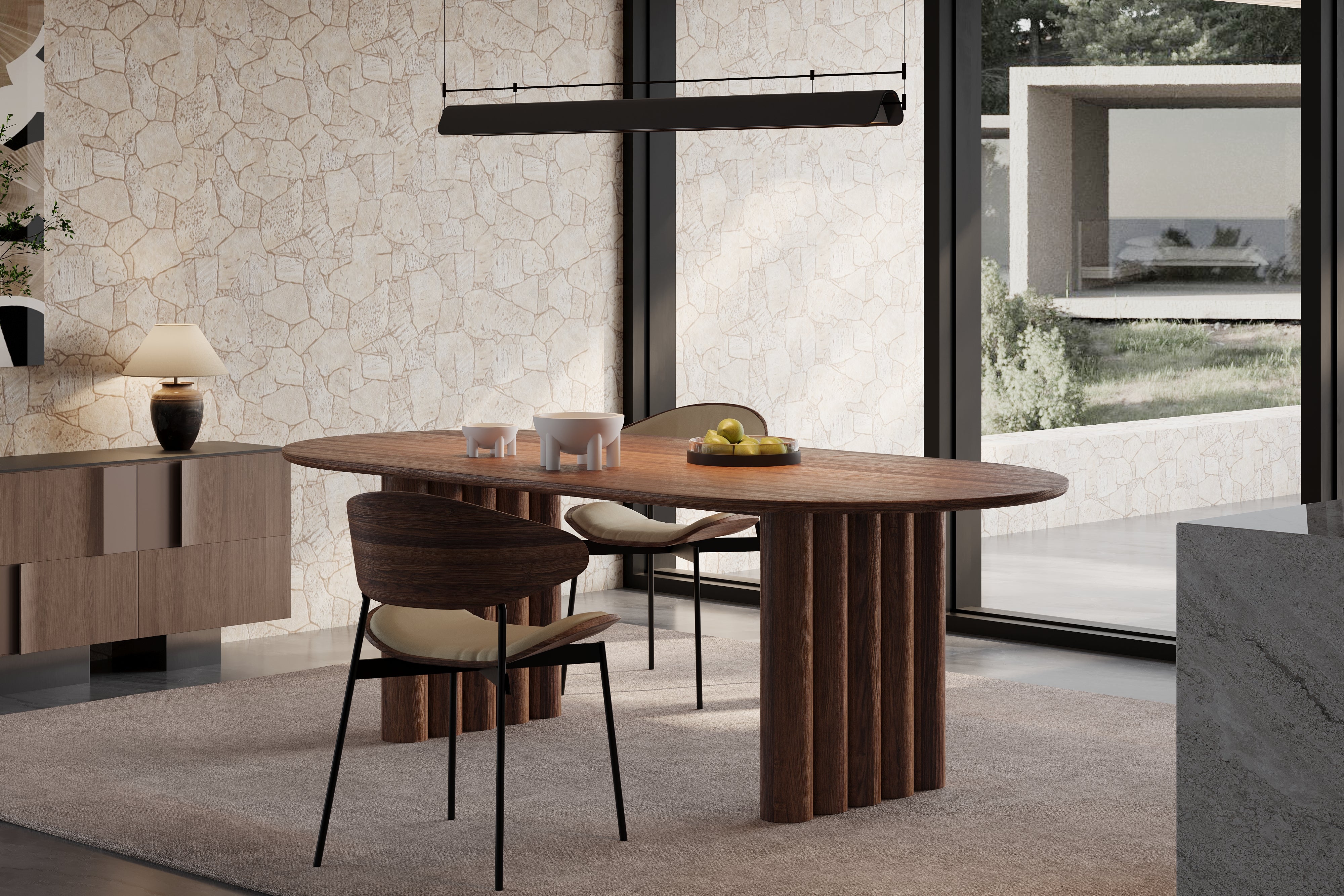
Shown: Etienne Hickory Wood Dining Table
Durability Is a Form of Sustainability
One of the most overlooked truths about eco-friendly furniture is that the most sustainable piece is often simply the one you don't have to replace. A well-built dining table or bed frame that lasts fifteen to twenty years, built from solid hardwood with joinery designed to be repaired rather than discarded, has a far smaller lifetime environmental footprint than a piece that costs less upfront but needs replacing every two or three years.
This is the practical case for investing in fewer, better pieces rather than furnishing a home with items designed for a short lifespan. A solid wood bed frame, for example, isn't just a design choice — it's a structural one. Real joinery and solid wood construction hold up to years of daily use in a way that particleboard and staples simply can't, which means fewer replacements, less waste, and ultimately a better long-term value even at a higher initial price point.

Shown: Leroy Solid Wood Bed Frame
Look Beyond the Furniture Itself
Sustainability in furniture also shows up in less visible ways: how a piece is packaged and shipped, whether it can be disassembled and moved rather than discarded when you relocate, and whether replacement parts or reupholstery are realistic options down the line. A piece designed with repairability in mind — replaceable cushion covers, accessible hardware, modular components — extends its useful life well beyond the original owner, which is one of the clearest forms of genuine sustainability in furniture design.
Care Extends Everything
Even the best-built furniture benefits from basic care: conditioning leather periodically, rotating and fluffing cushions, and avoiding prolonged direct sunlight that can dry out wood or fade fabric. None of this is complicated, but it's the difference between furniture that looks tired after five years and furniture that looks better with age.
How Eco-Friendly Furniture Fits Into a Healthier Home
The environmental case for better-made furniture is only half the picture. The materials that make furniture more sustainable also tend to make it healthier to live with. Low-VOC finishes mean fewer off-gassing chemicals in the air you and your family breathe, particularly in the first weeks after a new piece arrives, when off-gassing is typically at its highest. Natural fiber fills, like down and feather blends, don't rely on the flame-retardant chemical treatments sometimes used in lower-grade synthetic foams. None of this requires taking a brand's word for it — the details are usually available if you ask, and they're worth asking about for a piece that will sit in your living room or bedroom for years.
Solid Wood vs. Engineered Wood: What the Difference Really Means
It's worth understanding the practical difference here, since the terminology can be confusing. Engineered wood — particleboard, MDF, or plywood — is made by binding wood fibers or veneers together with adhesive under pressure. It's not inherently bad, and it has legitimate uses in furniture, but it's generally less durable over time and often relies on higher volumes of adhesive, some of which can off-gas VOCs. Solid wood, by contrast, is milled directly from timber and, when properly kiln-dried and finished, is dimensionally stable and can be repaired, sanded, and refinished for decades. For pieces that see heavy daily use — dining tables, bed frames, larger case goods — solid wood construction tends to be the more sustainable long-term choice, even though it usually costs more upfront.
Frequently Asked Questions
What actually makes furniture eco-friendly?
A few concrete factors separate genuinely lower-impact pieces from marketing language: solid wood frames from responsibly managed or reclaimed sources rather than particleboard or MDF bonded with heavy synthetic adhesives, natural cushion fills like down, feather, or latex that hold their shape far longer than lower-grade synthetic foam, and low-VOC finishes and water-based adhesives that release fewer airborne chemicals into the home.
What questions should I ask before buying eco-friendly furniture?
Ask what the frame is made from (solid wood, engineered wood, or metal), what fills the cushions and how it's constructed, what type of finish or stain is used on exposed wood, and whether the wood is sourced from a certified sustainable forestry program. Retailers who can answer clearly, without vague language, tend to be the ones actually paying attention to sourcing.
Why is durability considered a form of sustainability?
The most sustainable piece is often simply the one you don't have to replace. A well-built dining table or bed frame that lasts fifteen to twenty years, built from solid hardwood with repairable joinery, has a far smaller lifetime environmental footprint than a cheaper piece that needs replacing every two or three years.
What's the difference between solid wood and engineered wood?
Engineered wood — particleboard, MDF, or plywood — is made by binding wood fibers or veneers together with adhesive under pressure, and is generally less durable and reliant on more adhesive, some of which can off-gas VOCs. Solid wood is milled directly from timber and, when properly kiln-dried and finished, is dimensionally stable and can be repaired, sanded, and refinished for decades — making it the more sustainable long-term choice for heavy daily use pieces like dining tables and bed frames.
Shop This Post
A Sensible Approach to Furnishing
Choosing eco-friendly furniture doesn't require an all-or-nothing overhaul of how you shop. It means looking past the surface finish to ask what a piece is actually made of, how it's constructed, and how long it's realistically built to last. Solid materials, honest construction, and a design built for longevity will almost always outperform a cheaper alternative — both for your home and for the footprint it leaves behind. That's the thinking behind investing in fewer, better pieces rather than furniture meant to be replaced.
If that approach fits how you want to furnish your home, explore Finn & Form's Living Room collection for pieces built around solid materials and lasting construction.


