

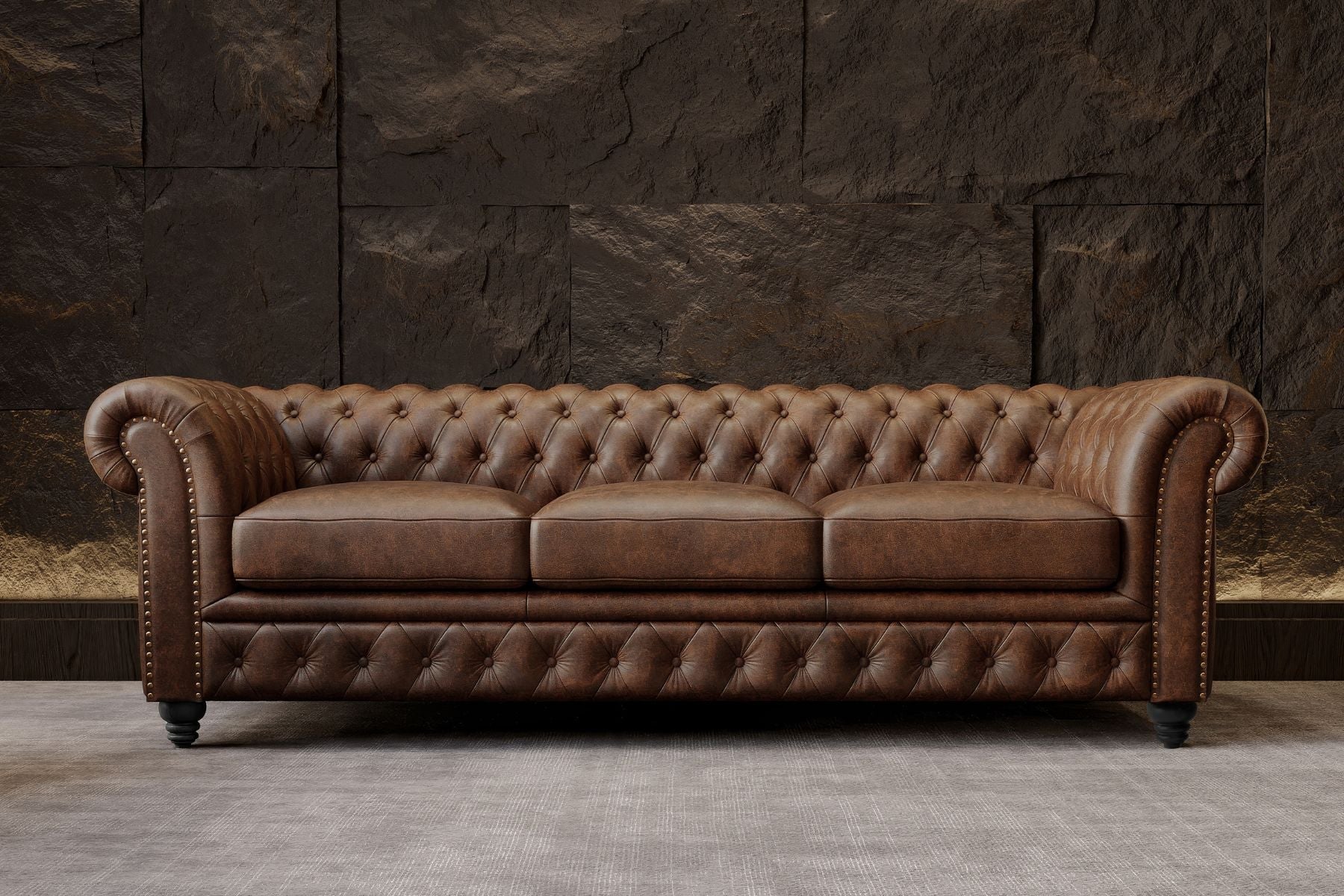
Few silhouettes are as instantly recognizable in furniture design as the Chesterfield sofa. With its deep button tufting, rolled arms, and low, tailored stance, it has held its place in living rooms, libraries, and studies for well over a century — and it shows no sign of going anywhere. If you're considering one for your own home, it helps to understand exactly what makes a Chesterfield a Chesterfield, how to choose between leather and fabric, and how to style it so it feels current rather than costume-like. This guide covers all of it.
What Is a Chesterfield Sofa?
A Chesterfield sofa is defined by a specific set of design features, not just a general "vintage" look. Genuine Chesterfield styling includes:
- Deep button tufting across the back and sometimes the seat, which creates the sofa's signature quilted texture and helps the upholstery hold its shape over years of use.
- Rolled or scroll arms that sit at the same height as the back of the sofa — this is one of the most identifying traits of the style, and it's what gives a Chesterfield its continuous, unbroken silhouette from arm to arm.
- Nailhead trim or a clean piped edge along the arms and base, depending on whether the design leans more traditional or more streamlined.
- A low-to-the-ground stance, with the seat sitting closer to the floor than most contemporary sofas, which is part of why the style reads as substantial and grounded in a room.
Put together, these elements create a sofa that looks tailored and architectural rather than soft and slouchy. That's the core appeal: a Chesterfield holds its structure, which is part of why the style has aged so well compared to trend-driven sofa designs that can start to look dated within a few years.
A Brief History of the Chesterfield Style
The Chesterfield takes its name from English club and library furniture traditions, where deep-buttoned leather seating was a fixture of formal sitting rooms, gentlemen's clubs, and studies. The style was built for durability and presence — leather that would age gracefully under regular use, and a silhouette formal enough to suit a room meant for conversation and reading rather than lounging. That heritage is part of why the Chesterfield still reads as a piece with substance: it wasn't designed as a passing trend, it was designed as furniture meant to last generations, and the design details reflect that intent.
Why the Chesterfield Style Has Stayed Popular
Most furniture styles cycle in and out of fashion within a decade or two. The Chesterfield has managed to stay relevant across radically different interior design eras — from traditional wood-paneled studies to minimalist modern lofts — for a simple reason: the tufted, rolled-arm silhouette is bold enough to be a genuine focal point, but disciplined enough that it doesn't fight with other design choices in the room. A Chesterfield can anchor a formal, heritage-style living room just as easily as it can serve as the one statement piece in an otherwise pared-back, contemporary space. Few sofa styles offer that kind of range.
Leather vs. Fabric Chesterfield Sofas
The original Chesterfield sofas were leather, and leather remains the classic choice for good reason. The way leather creases and softens along the tufted buttons and rolled arms is part of what gives a Chesterfield its character over time — the surface develops a lived-in richness that fabric doesn't replicate in quite the same way. Leather is also easier to keep clean day-to-day, since spills wipe off the surface rather than soaking into a woven fabric.
That said, a fabric Chesterfield is a legitimate and increasingly popular choice, especially for households that want a softer, more casual feel or that are drawn to a specific color or texture that isn't available in leather. Performance fabrics and boucle-style weaves in particular have made fabric Chesterfields more practical for everyday family use than they once were. The deciding factor usually comes down to the overall mood you want: leather leans tailored and traditional-to-transitional, while fabric can pull the same silhouette into a softer, more contemporary register.

Shown: Figaro Chesterfield Roll Arm Leather Sofa
The Figaro above is a good reference point for what a well-proportioned leather Chesterfield should look like: the rolled arms sit level with the back, the tufting is deep and evenly spaced, and the trim is clean rather than overdone. When you're comparing options, use details like these as your benchmark — a Chesterfield that skimps on arm height or tufting depth will lose the presence that makes the style worth choosing in the first place.
Sizing and Scale: What to Measure Before You Buy
Because a Chesterfield's rolled arms are wider and more substantial than a standard track or slope arm, the sofa takes up more overall depth and width than its seat width alone would suggest. When you're measuring your space, account for the arms as functional footprint, not just decoration — a Chesterfield with the same "3-seat" label as a different sofa style can end up several inches wider overall.
A few practical measuring steps:
- Measure the full width of the piece, arm to arm, not just the interior seating width, and compare that to your available wall space.
- Because the arms are level with the back, check the overall depth too — Chesterfields can read as visually "deeper" in a room than a sofa with a lower, sloped arm, even at a similar seat depth.
- Leave enough clearance around the piece for walking paths; a low, substantial sofa like a Chesterfield benefits from a bit of breathing room rather than being pushed tight against other furniture.
- If you're placing it in a smaller room, consider a loveseat-length or two-seat Chesterfield rather than a full three-seat version — the silhouette still reads clearly at a smaller scale.
How to Style a Chesterfield in a Modern Room
The tufting and rolled arms of a Chesterfield are already a strong visual statement, so the rest of the room should generally support that statement rather than compete with it. A few principles that work well:
Pair it with cleaner-lined pieces
Balance a Chesterfield's ornate detailing with simpler, straight-lined furniture elsewhere in the room — a low, minimal coffee table, unadorned media console, or streamlined accent chair. If everything in the room has heavy detailing, the Chesterfield loses its role as the focal point.

Shown: Maestro 3 Seater Leather Sofa
A sofa like the Maestro above illustrates the kind of clean-lined counterpoint that works well alongside a Chesterfield elsewhere in an open-plan space, or as a secondary seating piece in the same room — its uncluttered profile lets the Chesterfield's tufting stay the visual anchor rather than splitting attention between two competing statement pieces.
Keep the color palette restrained
A neutral or tonal palette — camel, cognac, charcoal, deep green — lets the silhouette do the work. Save bolder color for smaller accents like pillows or a throw rather than a second large upholstered piece.
Use it as a library or reading-nook anchor
Given its heritage in study and library settings, a Chesterfield works particularly well paired with a well-stocked bookshelf, a reading lamp, and a small side table — a setup that leans into the piece's original context rather than fighting it.
Caring for a Leather Chesterfield
Leather care for a Chesterfield follows the same general principles as any quality leather furniture, with a bit of extra attention to the tufted areas where dust and debris can settle into the seams.
- Wipe spills immediately with a clean, slightly damp cloth rather than letting liquid sit on the surface.
- Condition the leather every 6 to 12 months with a leather conditioner appropriate for your specific leather type, to keep it supple and prevent cracking, especially along the tufted buttons where the leather flexes most.
- Avoid direct, prolonged sun exposure, which can dry out and fade leather over time — position the sofa away from a spot that gets all-day direct sunlight if possible, or use window treatments to filter it.
- Dust regularly, including in and around the tufted seams, using a soft brush attachment or microfiber cloth.
With reasonable care, a well-made leather Chesterfield is a piece that improves with age rather than wearing out — the leather softening and taking on character precisely where you'd expect a much-loved sofa to show it.
Who a Chesterfield Sofa Is Right For
A Chesterfield tends to suit a specific kind of buyer well: someone furnishing a room that's meant to feel established and intentional rather than casual, or someone who wants a single statement piece that won't need replacing when the next furniture trend rolls through. It's a strong fit for a formal living room, a home office or study, or a den where the goal is a room that feels finished and considered. It's a slightly less natural fit for a high-traffic family room built around casual, everyday lounging, simply because the low seat and structured back are designed for upright, tailored sitting rather than sprawling out. That's not a flaw in the design — it's a reflection of what the silhouette was built to do, and it's worth keeping in mind when you're deciding where in your home the piece will live.
Common Questions When Shopping for a Chesterfield
Does a Chesterfield have to be brown leather?
No. While cognac and chocolate-brown leather are the most traditional Chesterfield colors, the style works in a wide range of leather tones — from deep charcoal to soft cream — as well as in fabric. The tufting and rolled-arm silhouette are what make it a Chesterfield, not the color.
Is a Chesterfield comfortable for everyday use?
Yes, though the seating experience is different from a deep, casual sofa. The low arms and firm, structured back are built for upright sitting and conversation rather than sprawling out, which is worth factoring in if you primarily want a sofa for stretching out to watch a long movie.
Can a Chesterfield work in a small space?
Yes — a two-seat or loveseat-length Chesterfield keeps the tufting and rolled-arm proportions intact at a smaller scale, and can work well as a single statement piece in an apartment living room or a reading nook.
Shop This Post
Finding the Right Chesterfield for Your Home
Whether you're drawn to the classic leather silhouette or a softer fabric interpretation, the Chesterfield remains one of the few sofa styles that works as a genuine long-term investment piece — one that anchors a room today and still looks intentional a decade from now. Explore Finn & Form's leather sofa collection to see the Figaro and other tufted, rolled-arm designs in full, or browse the complete sofa collection to compare Chesterfield styling against cleaner, more contemporary silhouettes side by side.


