

If you've stood in a furniture showroom or scrolled through options online wondering whether you need a loveseat or a full sofa, you're asking the right question — the two are often used almost interchangeably in casual conversation, but they serve genuinely different purposes in a room. Getting this decision right has a bigger impact on how your space actually functions than most other furniture choices, since it affects everything from seating capacity to how much floor space you have left for the rest of your layout. Here's how to tell them apart and figure out which one your room actually needs.
The Basic Difference: Size and Seating Capacity
A loveseat is a smaller upholstered seating piece designed to comfortably fit two people, typically running somewhere in the range of 52 to 70 inches wide. A standard sofa is built for three people (sometimes referred to as a "3-seater"), and generally spans 72 to 96 inches or more, depending on the design and arm style.
That size difference is the core of the distinction, but it has ripple effects beyond just seat count. A loveseat's smaller footprint means it can fit in spaces where a full sofa physically wouldn't, and it also tends to feel more intimate and casual, while a full sofa reads as the anchor piece of a larger room and can comfortably host more people at once.
When a Loveseat Makes More Sense
A loveseat is often the smarter choice in a few common scenarios:
- Small living rooms or apartments, where a full-size sofa would overwhelm the space or block walking paths. A loveseat lets you maintain comfortable seating without sacrificing the rest of the room's function.
- A secondary seating area — for instance, positioned perpendicular to a larger sofa to create a conversational furniture arrangement, or placed in a bedroom, home office, or bonus room where a full sofa isn't necessary.
- Pairing with a sectional or a larger sofa to add flexible extra seating without committing to another full-size piece. Two loveseats facing each other, or a loveseat paired with an accent chair, can create a more dynamic layout than one long sofa against a wall.
- Rooms with multiple purposes, such as a den that doubles as a guest space or a home office with a casual seating corner, where a smaller-scale piece fits the room's flexible use better than a large, dominant sofa.
When a Full Sofa Makes More Sense
A full-size sofa is generally the better choice when:
- It's your primary living room seating piece — the main spot where your household sits daily and where guests will gather when they visit.
- You regularly host groups, whether that's family gatherings, movie nights with friends, or a household with several people who all want to sit together comfortably at once.
- The room's proportions call for a larger anchor piece — in a larger living room, a loveseat alone can look undersized and leave the space feeling sparse, while a full sofa fills the role of visual and functional anchor more naturally.

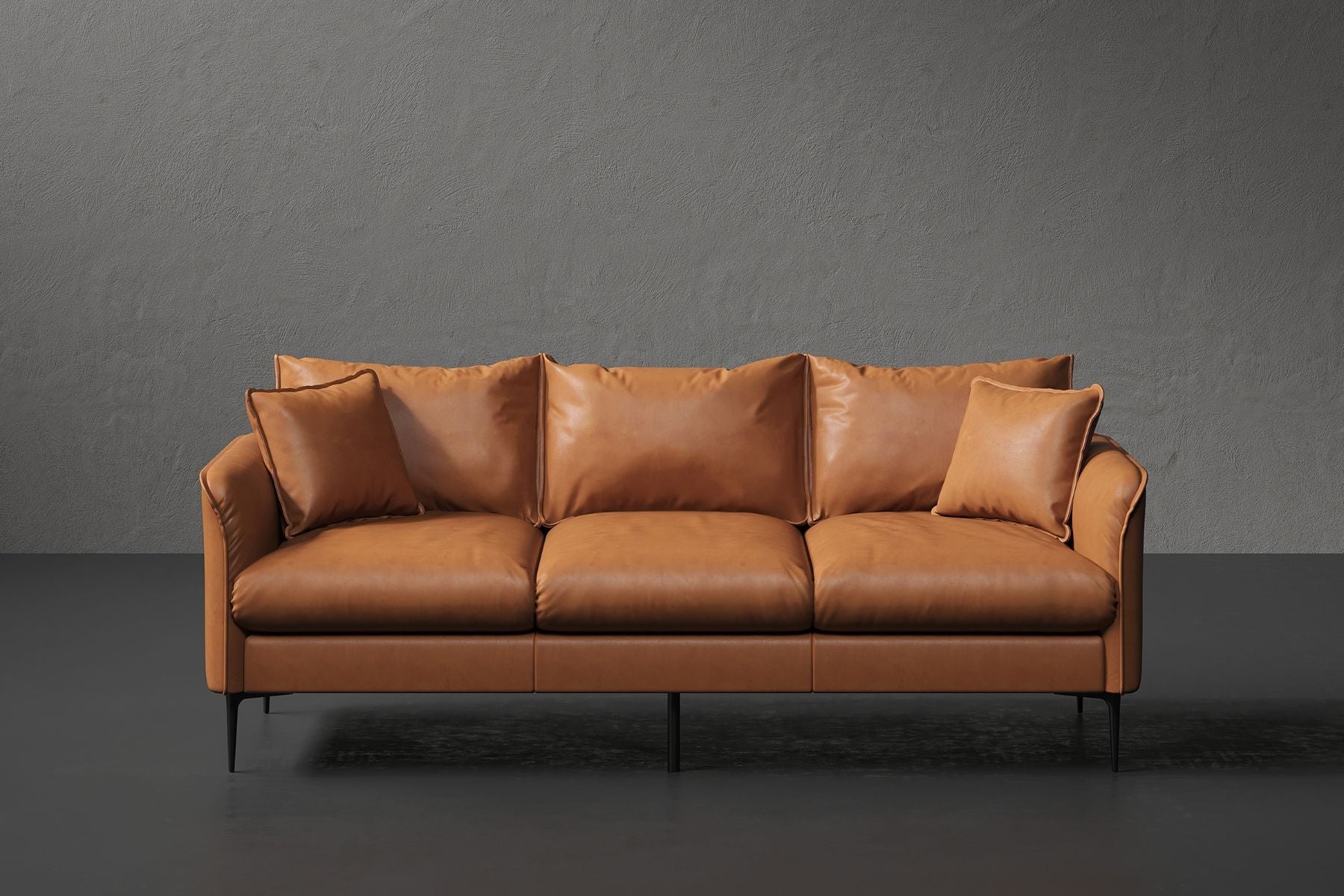
Shown: Stockholm 3 Seater Leather Sofa
A sofa like the Stockholm above is built for exactly that primary-seating role — it's sized to comfortably seat three, making it a natural fit for a household's main gathering point, whether that's daily family time or hosting a group of friends.
How a Loveseat and Sofa Can Work Together in One Room
One of the most practical layouts in furniture planning isn't choosing one over the other — it's combining them. A loveseat paired with an accent chair, or a loveseat placed alongside a full sofa, can offer roughly the same total seating capacity as a single larger three-seat sofa, while opening up more floor space and giving the room a more flexible, conversational layout. Rather than everyone facing one direction toward a single long sofa, a mixed arrangement lets people face each other, which tends to make a living room feel more inviting for actual conversation.

Shown: Aria Leather Lounge Chair & Ottoman
A lounge chair and ottoman like the Aria above is a good example of this kind of flexible pairing — positioned alongside a loveseat, it adds a comfortable individual seat (with a footrest, which a loveseat alone doesn't offer) without requiring the floor space a second full sofa would take up. This kind of mix-and-match approach is especially useful in living rooms that need to serve more than one function, since individual pieces can be rearranged more easily than one large sectional or sofa.
Material and Style Considerations Apply to Both
It's worth noting that the material and style decisions you'd make for a full sofa — leather versus fabric, tailored versus relaxed arm styles, firm versus plush cushioning — apply equally to a loveseat. A loveseat isn't a "lesser" or more limited version of a sofa in terms of quality or design options; it's simply a smaller-capacity piece, and it's worth holding it to the same standards for comfort, construction, and materials that you would a full-size sofa. If anything, because a loveseat is often the more visible piece in a smaller room, it's worth being just as selective about finish and detailing as you would with a larger anchor sofa.
Loveseat and Sofa Sizing at a Glance
As a general rule of thumb, most loveseats fall between 52 and 70 inches wide and comfortably seat two people, while standard sofas run from about 72 to 96 inches (with larger or sectional pieces extending well beyond that) and are built for three or more. These ranges vary by manufacturer and design, so always check the specific dimensions of a piece rather than assuming based on the "loveseat" or "sofa" label alone — some compact sofas and larger loveseats overlap in size, and the labels are ultimately just a shorthand for the seating capacity a piece is designed around.
A Few Questions to Help You Decide
How many people usually sit down at once?
If it's rarely more than two, a loveseat may cover your daily needs, with additional seating from an accent chair or ottoman for guests. If you regularly have three or more people sitting together, a full sofa is the more practical choice.
How much floor space do you actually have?
Measure your room and map out walking paths before deciding. A full sofa that technically fits against one wall can still make a small room feel cramped if it doesn't leave enough clearance elsewhere.
Is this a primary or secondary seating piece?
Primary living room seating generally calls for a full sofa's capacity. Secondary spaces — a reading nook, a home office corner, a guest room — are often better served by a loveseat's smaller footprint.
Shop This Post
Finding the Right Fit
Whether your room calls for the capacity of a full sofa, the flexibility of a loveseat, or a combination of both, the goal is the same: seating that fits your space and how you actually use it, not just what looks good in a showroom. Browse Finn & Form's loveseat collection to compare options, or pair a loveseat with a full sofa or accent chair to build a layout that gives your living room both comfort and flexibility.


